How to Pray the Divine Mercy Chaplet, Step by Step
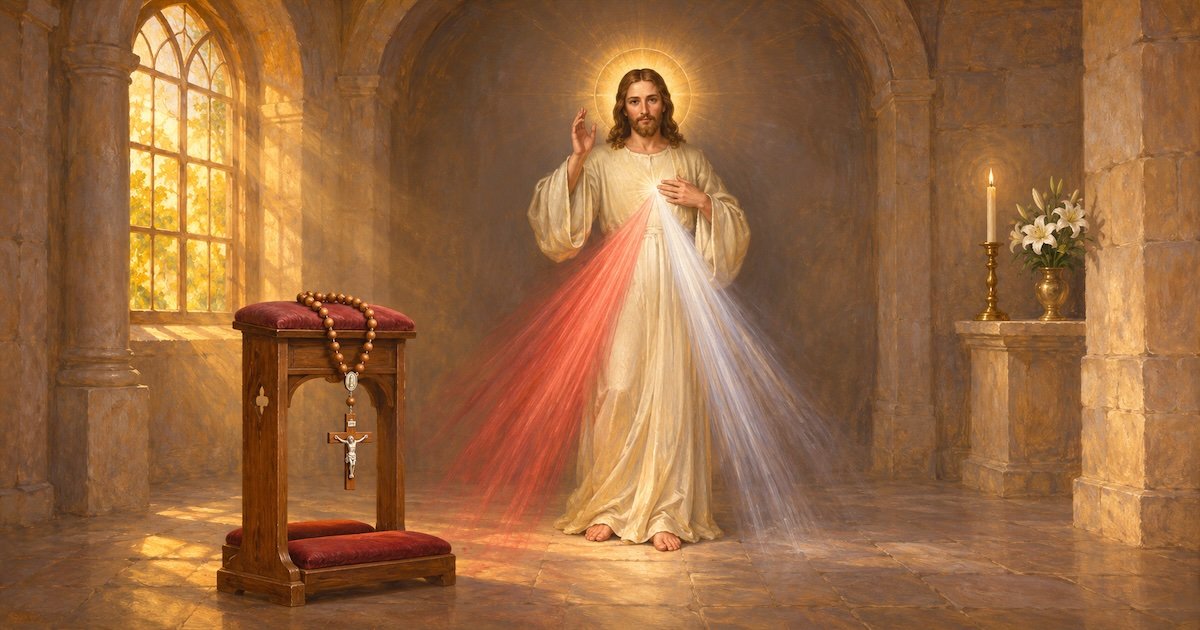
The Divine Mercy Chaplet is a short prayer, about seven minutes, that you pray on ordinary rosary beads. It was given by Jesus to a young Polish nun, Saint Faustina, in the 1930s, and it has become one of the most loved prayers in the Church.
Here is how to pray it, step by step, with every prayer written out, and why it is so powerful.
Where does the Divine Mercy Chaplet come from?
Saint Faustina Kowalska (1905–1938) was a simple Polish sister, with little schooling, who worked in her convent's kitchen, garden and gate. Jesus revealed himself to her as the Divine Mercy, and asked her to make his mercy known to the whole world. She wrote down what she received in a diary, now published as Divine Mercy in My Soul.
In 1935, in Vilnius, Jesus taught her this chaplet. Its message is simple and at the heart of the Gospel: God's mercy is greater than any sin, and he waits for us to turn to him with trust. That is why the prayer that sums up the whole devotion is just five words: "Jesus, I trust in You."
Saint John Paul II, himself Polish, canonized Saint Faustina on 30 April 2000 and, at that Mass, announced that the Second Sunday of Easter would be celebrated by the whole Church as Divine Mercy Sunday.
🙏 Pray the Divine Mercy Chaplet with every prayer on screen in Catho+ →
What is a "chaplet"?
A chaplet is a prayer said on beads, like the Rosary, but shorter and with its own prayers. The Divine Mercy Chaplet uses an ordinary rosary: the same crucifix, the same large and small beads, the same five decades. Only the words change. (If you are new to the beads themselves, our guide How to pray the Rosary explains how a rosary is made.)
No rosary at hand? Use the Rosary Beads in Catho+: swipe each bead as you pray and let the app keep count, for the chaplet as for the Rosary.
Unlike the Rosary, the Divine Mercy Chaplet does not ask you to meditate on a different mystery for each decade. The whole chaplet keeps one thing before your eyes: the Passion of Jesus, his suffering and death on the Cross, offered to the Father out of love for us.
How to pray the Divine Mercy Chaplet, step by step
- On the crucifix: make the Sign of the Cross.
- On the beads before the first decade: pray one Our Father, one Hail Mary and the Apostles' Creed. (Don't worry about matching each prayer to a bead here; what matters is to say these three before you begin.)
- On each large bead (at the start of each decade), pray: "Eternal Father" (see below).
- On each of the ten small beads, pray: "For the sake of his sorrowful Passion" (see below).
- Repeat steps 3 and 4 for all five decades.
- To conclude, pray three times: "Holy God" (see below).
- If you wish, add the optional closing prayer, then make the Sign of the Cross.
That's it. Once you have prayed it two or three times, you will know it by heart.
The prayers of the chaplet
On the large beads: "Eternal Father"
Eternal Father, I offer you the Body and Blood, Soul and Divinity of your dearly beloved Son, Our Lord Jesus Christ, in atonement for our sins and those of the whole world.
On the small beads: "For the sake of his sorrowful Passion"
For the sake of his sorrowful Passion, have mercy on us and on the whole world.
To conclude, three times: "Holy God"
Holy God, Holy Mighty One, Holy Immortal One, have mercy on us and on the whole world.
Optional closing prayer
Eternal God, in whom mercy is endless and the treasury of compassion inexhaustible, look kindly upon us and increase your mercy in us, that in difficult moments we might not despair nor become despondent, but with great confidence submit ourselves to your holy will, which is Love and Mercy itself. Amen.
The Our Father, the Hail Mary and the Apostles' Creed
These are the same prayers as in the Rosary. You will find them written out in full in our guide How to pray the Rosary.
What does "I offer you the Body and Blood, Soul and Divinity" mean?
This sentence can seem strange at first. Who are we to "offer" Jesus to the Father?
Here is the idea. On the Cross, Jesus offered his whole self to the Father for the salvation of the world. At every Mass, the priest offers that same sacrifice. Through our baptism, every Christian shares in some way in this offering: we can unite ourselves to it and present it to the Father, asking him, because of it, to have mercy on the world.
"Body and Blood, Soul and Divinity" is simply a way of saying all of Jesus, his humanity and his divinity, the same words the Church uses to speak of his presence in the Eucharist. In other words, we are not offering God something of our own. We are offering him the most precious thing there is, his own Son, and asking: for his sake, have mercy.
And notice the words "on us and on the whole world". The chaplet is never a private prayer. Each time we pray it, we pray for everyone: sinners, the dying, people who do not know God, people who have no one to pray for them.
When to pray the Divine Mercy Chaplet
- At three o'clock in the afternoon. This is the hour Jesus died on the Cross, called the Hour of Mercy. Jesus asked Saint Faustina to remember his Passion at that hour, even if only for a moment. If you can't pray the whole chaplet at 3 pm, a short "Jesus, I trust in You" is already a beautiful prayer.
- For the dying. Saint Faustina wrote that Jesus promised special graces to the dying when the chaplet is prayed beside them. Many families and nurses pray it at a bedside.
- In the Divine Mercy Novena. The chaplet is prayed for nine days from Good Friday, leading up to Divine Mercy Sunday, each day for a different group of people.
- Any day, any time. In the car, on a walk, in a waiting room. It is short enough to fit almost anywhere.
Common questions
Do I need special beads?
No, an ordinary rosary works perfectly. Some Divine Mercy chaplets are sold on their own, but they are not necessary. You can even count on your fingers, or use the Rosary Beads in Catho+.
Can I sing it?
Yes. There are many sung versions, and singing it in a group is very moving. Some parishes sing it together at 3 pm on Fridays or on Divine Mercy Sunday.
Can I pray it in a group?
Yes. The leader says the first part of each prayer ("Eternal Father, I offer you…" or "For the sake of his sorrowful Passion"), and everyone answers with the second part ("in atonement for our sins…" or "have mercy on us and on the whole world").
Is it the same as the Rosary?
No. They use the same beads, but they are two different prayers. The Rosary contemplates the whole life of Jesus with Mary; the Divine Mercy Chaplet focuses on his Passion and asks for mercy for the world. Many people pray both.
| Pray the Divine Mercy Chaplet in Catho+ |
In Catho+, the Divine Mercy Chaplet is always with you, every prayer on screen, so you can pray it anywhere, even at 3 pm on a busy day.
Jesus, I trust in You.