What Is a Patron Saint? And Who Is the Patron Saint of...?
A patron saint is a saint the Church, or long Christian tradition, has given a special care for a person, a place, a group or a need: a country, a parish, a job, a sickness, the person who bears their name. Catholics do not pray to patron saints instead of God. They ask them to pray for them, the way you might ask a good friend, except that this friend is already with God.
Below: where patronages come from, how to choose your own, and a list of the patron saints people look for most, marking which were declared by a pope and which come from tradition.
What is a patron saint?
The word comes from the Latin patronus, a protector who speaks up for you. A patron saint is a friend in heaven with a particular "file" on his or her desk. Saint Anthony has the lost keys. Saint Cecilia has the choir. Saint Joseph has the whole Church.
Why ask the saints to pray for us at all? Because death does not break the family of God. The Catechism explains that the saints in heaven, being closely united to Christ, do not stop interceding with the Father for us, always through the one mediator, Jesus Christ, and that their brotherly concern is a real help to our weakness (see Catechism, 956). It quotes Saint Thérèse of Lisieux: "I want to spend my heaven in doing good on earth."
Later, speaking about prayer, the Catechism calls the saints a "cloud of witnesses" who contemplate God, praise him and keep caring for those they left on earth. Their intercession, it says, is their highest service to God's plan, and we can and should ask them to pray for us and for the whole world (see Catechism, 2683).
When you face something hard, you ask your mother or your friends to pray for you, and nobody thinks that takes anything away from God. Asking a saint is the same gesture, made towards members of the family who now see God face to face. Worship belongs to God alone; the saints are our older brothers and sisters, not his rivals. (Christians of other traditions see this in different ways; our guide to Catholics and other Christians talks about what we share.)
🕯️ Meet a new saint every morning with the saint of the day in Catho+ →
How does a saint become a patron?
No office in Rome hands out every patronage. Most grew up in one of three ways.
1. A link with the saint's life
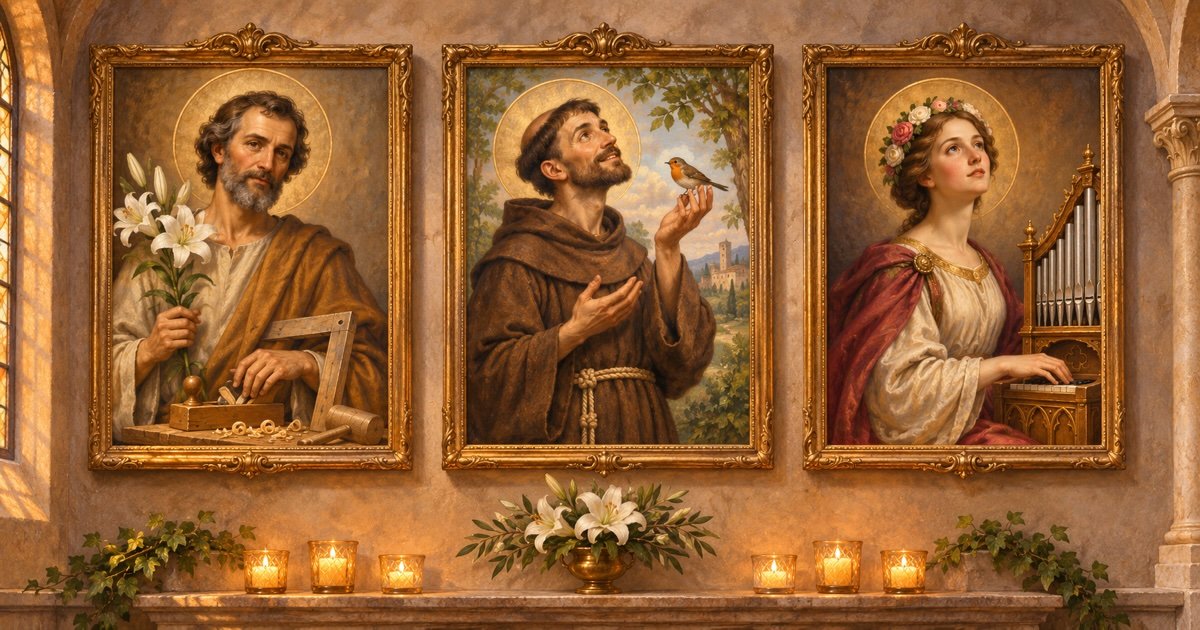
Very often the patronage simply follows the saint's story. Saint Luke is the patron of doctors because Saint Paul calls him "the beloved physician" (Colossians 4:14). Saint Joseph, a craftsman who worked with his hands, is the patron of workers. Saint Francis of Assisi, who preached to the birds and sang the Canticle of the Creatures, is the friend of animals.
2. Tradition and the prayer of the faithful
Sometimes ordinary believers prayed to a saint for a certain need, were helped, told others, and over the generations the habit became tradition. That is how Saint Anthony of Padua became the saint of lost things, and Saint Gerard Majella the saint of expectant mothers. Nobody signed a decree; the people of God simply knew.
3. An official declaration by the Pope
Some patronages were declared officially by a pope, often at the request of bishops or of the faithful. A few famous examples:
- Saint Joseph, Patron of the Universal Church, declared under Blessed Pius IX on 8 December 1870, by the decree Quemadmodum Deus.
- Saint Thomas Aquinas, patron of Catholic universities and schools, declared by Leo XIII in 1880.
- Saint Francis of Assisi and Saint Catherine of Siena, patrons of Italy, declared by Pius XII on 18 June 1939.
- Saint Benedict, patron of Europe, declared by Saint Paul VI in 1964.
Patron saints of countries, jobs, parishes and people
Countries and cities
Most Catholic countries, regions and cities have a patron, often the saint who first preached there or the one whose shrine the people loved. Some were confirmed by a pope. Your diocese or bishops' conference can tell you yours.
Jobs and states of life
Almost every trade has its saint. It is a reminder that holiness is not only for monks and nuns: a teacher can become a saint by teaching, a nurse by nursing, a father by raising his children.
Parishes and churches
Every Catholic church has its own "title" (Saint Mary's, Holy Trinity, Sacred Heart), which cannot be changed once the church has been dedicated (Code of Canon Law, canon 1218). When the title is a saint, that saint is the parish's patron, and the parish celebrates the feast with special joy. (Curious about the different kinds of churches? See cathedral, basilica, church: what is the difference?)
Your own name: baptism and confirmation
The most personal patron of all is the saint whose name you carry. The Catechism explains that in Baptism the Christian receives his or her name in the Church. That name can be the name of a saint, a disciple who lived a life of exemplary fidelity to the Lord. The patron saint, it says, gives us a model of charity and the assurance of his or her prayer. The name can also express a Christian mystery or virtue, and parents, godparents and the pastor should make sure it is not foreign to Christian sense (see Catechism, 2156). (More on Baptism in our guide to the seven sacraments.)
In many countries, it is also the custom for those being confirmed to choose a saint's name for Confirmation, as a new patron for their Christian life. Practice varies from place to place, so ask your parish.
How to choose a patron saint
You do not need permission to make a saint your patron. Like any friendship, it often begins by chance and grows with time. A few ways to find yours:
- Start with your name. Find out who your name saint is and read his or her life. You may be surprised.
- Look at your life. Your job, your country, your illness, your vocation as a mother, a student, a soldier: there is almost certainly a saint who walked the same road.
- Look at your heart. Is there a saint whose story moves you, whose words you keep coming back to? That is often a sign.
- Let the saints find you. Read about one saint each day; some will stay with you. Then learn their feast day and ask for their prayers.
Who is the patron saint of...? The most searched patronages
Here are the patronages people look for most. "Declared" means a pope or the Holy See made it official; "tradition" means it grew from the faith and prayer of the people over the centuries. A patronage from tradition is not "less true"; it simply was not decreed.
Everyday needs
- Lost things: Saint Anthony of Padua (tradition). The best-known story tells of a precious book of psalms that was taken from him and given back after he prayed. Pray the Novena to Saint Anthony.
- Animals: Saint Francis of Assisi (tradition). Many parishes bless animals around his feast, 4 October. He is also the declared patron of those who promote ecology (Saint John Paul II, 1979).
- Impossible and desperate causes: Saint Jude (tradition). The apostle Jude was long neglected, because his name sounded like Judas, so people turned to him when everything else had failed. Pray the Novena to Saint Jude.
- Travelers: Saint Christopher (tradition). His feast was moved from the universal calendar to local calendars in 1969, but he is still a saint, listed among the martyrs of the Roman Martyrology.
- The internet: Saint Isidore of Seville is often proposed, because he wrote a great encyclopedia of all the knowledge of his time. But this is not official: the Church has never declared a patron of the internet.
Family and life
- Mothers: Saint Monica (tradition). She prayed for years, with many tears, for the conversion of her son, who became Saint Augustine.
- Expectant mothers: Saint Gerard Majella (tradition). Many graces in difficult pregnancies are attributed to this Redemptorist brother.
- A happy death, the dying: Saint Joseph (tradition). Tradition holds that he died with Jesus and Mary at his side. Pray the Novena to Saint Joseph.
- The sick with cancer: Saint Peregrine (tradition). He suffered from a disease of the leg so serious that it was to be amputated; after a night of prayer, it was healed.
Work and study
- Workers: Saint Joseph the Worker. Pius XII instituted the feast of Saint Joseph the Worker on 1 May 1955, so that workers would not lose the Christian meaning of work.
- Students and Catholic schools: Saint Thomas Aquinas (declared patron of Catholic universities, academies and schools by Leo XIII, 1880; students in general by tradition).
- Teachers: Saint John Baptist de La Salle (declared by Pius XII on 15 May 1950). He founded the Brothers of the Christian Schools.
- Doctors: Saint Luke, and Saints Cosmas and Damian (tradition). Luke was a physician; Cosmas and Damian, martyrs of the early Church, are remembered as doctors who cared for the sick without payment. Their names are still said in the First Eucharistic Prayer of the Mass.
- Musicians: Saint Cecilia (tradition). The story of her martyrdom says that at her wedding, while the music played, she sang to God in her heart.
- Soldiers, police officers and paramedics: Saint Michael the Archangel (tradition), among many others who protect and rescue. Scripture shows him leading the battle against evil, and those who face danger to keep others safe have long asked for his protection.
- Missions: Saint Francis Xavier and Saint Thérèse of Lisieux (declared by Pius XI in 1927). Thérèse never left her convent, but offered her life in prayer for missionaries. Pray the Novena to Saint Thérèse.
Continents and countries
- Europe: Saint Benedict (declared by Saint Paul VI, 1964), with Saints Cyril and Methodius (declared by Saint John Paul II, 1980), and Saints Bridget of Sweden, Catherine of Siena and Teresa Benedicta of the Cross (Edith Stein) as co-patronesses (declared by Saint John Paul II, 1 October 1999).
- The Americas: Our Lady of Guadalupe (declared). Pius XII honored her as Empress of the Americas in 1945, and Saint John Paul II, in Ecclesia in America (1999), invoked her as Patroness of all America and asked that her feast be celebrated on 12 December throughout the continent.
- Brazil: Our Lady of Aparecida (declared by Pius XI, 1930, at the request of the Brazilian bishops). Her feast, 12 October, is a national holiday.
- France: Our Lady of the Assumption, principal patroness, with Saint Joan of Arc (both declared by Pius XI, 1922), and Saint Thérèse of Lisieux (declared by Pius XII, 1944).
- Mexico: Our Lady of Guadalupe (declared). Her patronage was confirmed by Pope Benedict XIV in the eighteenth century.
- The Philippines: the Immaculate Conception, principal patroness, with Saint Pudentiana and Saint Rose of Lima (declared by Pius XII, 1942).
- Portugal: the Immaculate Conception, proclaimed patroness of the kingdom by King John IV in 1646, with Saint Anthony of Lisbon (known elsewhere as Anthony of Padua, born in Lisbon) and Saint Francis Borgia (Saint Anthony declared by Pius XI, 1934).
- Spain: Saint James the Apostle (Santiago), patron by a tradition of many centuries, and the Immaculate Conception, patroness (declared by Clement XIII, 1760).
- The United States: the Immaculate Conception (chosen by the American bishops in 1846, and approved by Blessed Pius IX in 1847).
- Italy: Saint Francis of Assisi and Saint Catherine of Siena (declared by Pius XII, 1939).
- The whole Church: Saint Joseph (declared, 1870).
And when you do not know which saint to ask, ask them all: the Litany of the Saints calls on the whole family of heaven at once.
| Find my Patron Saint |
In Catho+, find your patron saint by name, meet the saint of the day every morning, and pray the novenas to Saint Anthony, Saint Jude, Saint Joseph and Saint Thérèse.