What Is the Difference Between a Cathedral, a Basilica and a Church?
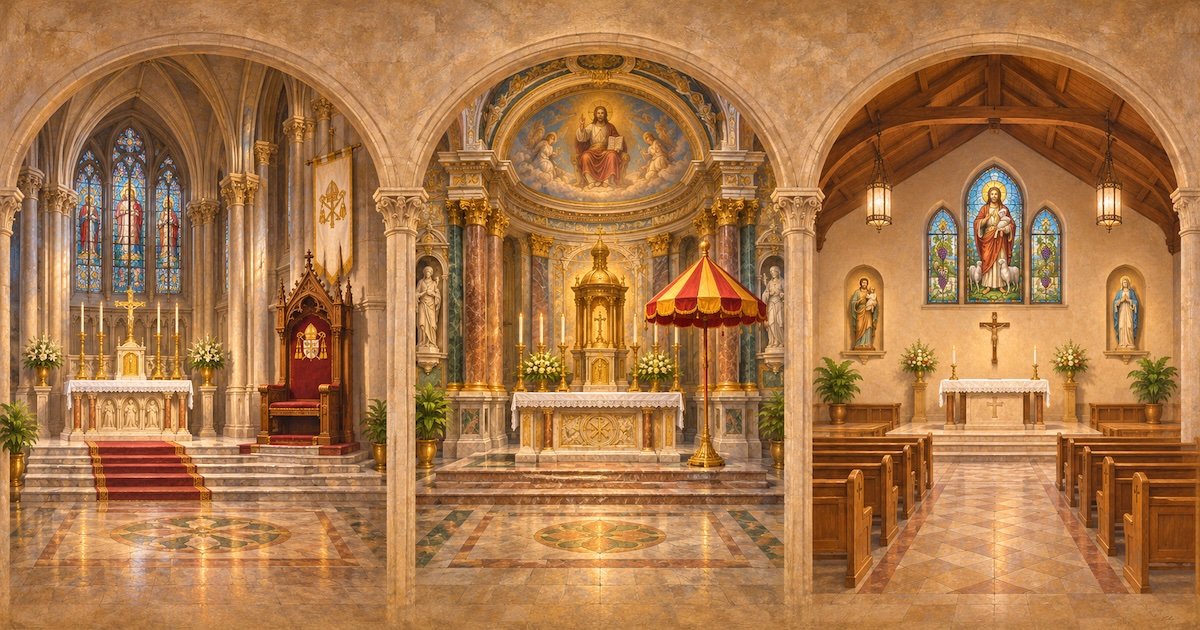
Every cathedral and every basilica is a church, but not every church is a cathedral or a basilica. A cathedral is the church where the bishop has his chair, the main church of a diocese. A basilica is a church that the Pope has honored with a special title. A building can be one, the other, both, or neither: it is not a question of size or beauty, but of role and of honor.
Let us walk through the words you see on signs and maps (church, parish, cathedral, basilica, chapel, oratory, shrine, abbey) and see what each one really means.
The church: God's house among his people
In the Church's law, a church is a sacred building set apart for divine worship, where all the faithful have the right to come in and pray, especially to take part in public worship such as Mass (see Code of Canon Law, canon 1214). That last point matters: a church is open to everyone, not reserved to a small group.
The Catechism explains why these buildings exist at all: when they are free to do so, Christians build places for worship. And these buildings are more than meeting halls:
"These visible churches are not simply gathering places but signify and make visible the Church living in this place, the dwelling of God with men reconciled and united in Christ." (Catechism of the Catholic Church, 1180)
Notice the two meanings of the word. With a capital C, the Church is the people of God, the family of all the baptized. With a small c, a church is the building where that family gathers. The stone church is a sign of the living Church.
And the parish church?
A parish is not a building but a community: a stable community of the faithful within a diocese, entrusted to a pastor (a parish priest) under the authority of the bishop (canon 515). Most parishes are territorial: if you live within their boundaries, you belong to them. Some are "personal" parishes, created for example for a particular language, rite or nationality (canon 518).
The parish church is the home of that community: the church where you are usually baptized, married and buried, where the parish gathers every Sunday. For most Catholics, this is "my church". A parish can also have other churches or chapels besides its main one.
⛪ Find churches and Mass times near you, at home or on the road, in Catho+ →
The cathedral: where the bishop has his chair
The word "cathedral" comes from the Latin cathedra, which means chair. A cathedral is the church that holds the bishop's chair, the sign of his mission to teach, sanctify and guide the people of his diocese. When you visit a cathedral, look for it: a special seat in the sanctuary, often raised and more solemn than the others.
That is why a cathedral is defined by what it is for, not by how it looks. Some cathedrals are immense Gothic masterpieces, like Notre-Dame in Paris. Others are modest buildings in young or small dioceses, simpler than many parish churches nearby. What makes them cathedrals is the chair, and the bishop who sits in it.
As a rule, each diocese has one cathedral: it is the mother church of all the parishes of the diocese. Two variations exist that you may come across:
- A co-cathedral is a second cathedral in the same diocese, which shares the role with the main one. This often happens when two dioceses have been joined, or when a diocese has two important cities. For example, the Archdiocese of Galveston-Houston, in Texas, has its cathedral in Galveston and the Co-Cathedral of the Sacred Heart in Houston.
- A pro-cathedral is a church that serves as the cathedral "in place of" one, often for a time. The best-known example is St Mary's Pro-Cathedral in Dublin, which has served as the seat of the Catholic Archbishop of Dublin for two centuries.
Did you know? The Pope's cathedral is not St Peter's
The Pope is the Bishop of Rome, so he too has a cathedral. And it is not St Peter's Basilica, but the Archbasilica of St John Lateran. It is the official cathedral of Rome, where the chair of the Bishop of Rome stands, and it bears the proud title of "mother and head of all churches of the city and of the world". The Church celebrates the anniversary of its dedication every year, on 9 November, as a feast for the whole world.
St Peter's, for its part, is a basilica, built over the tomb of the Apostle Peter, and the place of so many great papal celebrations. Famous, immense, beloved, but not a cathedral.
The basilica: a title of honor from the Pope
This is the word that confuses people most, because it has two meanings.
In architecture, a "basilica" is a style of building: a long hall with a central nave and side aisles, inherited from the public halls of ancient Rome. The first great Christian churches were built on that plan.
But in the Church's life today, "basilica" is a title of honor, granted by the Pope to a church because of its importance: its history, its art, its role in the life of faith of a region, the quality of its liturgy. A basilica is a kind of church that the Pope "adopts" in a special way, a sign of its close bond with the Bishop of Rome.
Major and minor basilicas
- There are four major basilicas, also called papal basilicas, all in Rome: St John Lateran, St Peter's, St Mary Major and St Paul Outside the Walls. St John Lateran, the Pope's cathedral, ranks first among them and is called an "archbasilica".
- All other basilicas are minor basilicas. There are many hundreds of them throughout the world, in cities, villages and places of pilgrimage. "Minor" does not mean small: it simply distinguishes them from the four great basilicas of Rome.
What does the title change?
The rules for minor basilicas were set out by the Holy See in a 1989 decree known as Domus Ecclesiae. The title is both an honor and a responsibility: a basilica is expected to be a model of liturgy for its region, and to help the faithful know and love the Pope's teaching. A few visible signs come with it:
- The crossed keys. A basilica may display the papal symbol, the keys of Saint Peter, on its banners, its furnishings and its seal. Look for them above the door or on the processional banners.
- A plenary indulgence on certain days. The faithful who devoutly visit a basilica on certain days of the year, which each basilica announces, and take part in a sacred rite there or at least pray the Our Father and the Creed, may receive a plenary indulgence under the usual conditions (confession, Communion and prayer for the Pope's intentions).
A cathedral can also be a basilica, and a basilica can be a parish church. The two titles do not depend on each other: one is about the bishop's chair, the other about an honor given by the Pope.
Chapels and oratories: smaller places of prayer
In everyday language, a chapel is any small place of prayer: a side chapel inside a large church, the chapel of a hospital, a school, an airport or a convent. Church law is more precise and distinguishes two kinds:
- An oratory is a place of worship set up, with the permission of the bishop or competent superior, for a community or group of the faithful (a religious house, a seminary, a school, a hospital). Others may come in with the consent of the superior (canon 1223). Most sacred celebrations, including Mass, can take place there (canon 1225).
- A private chapel is a place of worship set up, with the permission of the local bishop, for the benefit of one or a few people (canon 1226). Mass or other celebrations there need the bishop's permission (canon 1228).
The key difference from a church is access: a church is open to all the faithful, while an oratory or a chapel serves a particular community or person.
The shrine: a place of pilgrimage
A shrine (also called a sanctuary) is a church or other sacred place to which many of the faithful make pilgrimage for a special reason of piety, with the approval of the local bishop (canon 1230). The reason might be an apparition of Our Lady, the tomb or relics of a saint, a miraculous image, or a long tradition of prayer.
Shrines can be diocesan, national or international. A national shrine needs the approval of the bishops' conference, and an international shrine the approval of the Holy See (canon 1231). And because people come from far away, often carrying heavy burdens, the Church asks shrines to offer the means of salvation more abundantly: the preaching of the Word of God, the celebration of the Eucharist and of confession, and approved forms of popular devotion (canon 1234).
Here too, titles can be combined. In Washington, D.C., the Basilica of the National Shrine of the Immaculate Conception is at once a national shrine and a minor basilica, but not the cathedral: the cathedral of the Archdiocese of Washington is St Matthew's.
The abbey and the monastery church
A monastery is the home of a community of monks or nuns who live together under a rule of life, such as the Rule of Saint Benedict, devoted to prayer and work. An abbey is a monastery governed by an abbot (for monks) or an abbess (for nuns).
The abbey church or monastery church is the church at the heart of the monastery, where the community gathers several times a day to sing the Liturgy of the Hours and to celebrate Mass. Many welcome visitors to join them in prayer. Some abbey churches have also received the title of basilica.
In summary
- Church: a sacred building for divine worship, open to all the faithful.
- Parish church: the church of a parish, the local community entrusted to a pastor. "Your" church.
- Cathedral: the church of the bishop's chair (cathedra), the mother church of a diocese. Usually one per diocese.
- Basilica: a title of honor given by the Pope. Four major (papal) basilicas in Rome, and many minor basilicas worldwide.
- Oratory and chapel: places of worship for a particular community or for a few people.
- Shrine (sanctuary): a church or sacred place of pilgrimage, approved by the bishop.
- Abbey church: the church of a monastery, where monks or nuns pray together each day.
And remember: whatever its title, every Catholic church holds the same treasure. The humblest country chapel and the greatest basilica both welcome the same Lord, present in the Eucharist. If you want to discover what is celebrated there, see our guide to the seven sacraments, and when you visit, notice the color the priest wears: our guide to the liturgical colors explains what it means.
| Find a church near you in Catho+ |
In Catho+, you can find the churches near you and their Mass times, wherever you are.