What Are the Seven Sacraments of the Catholic Church?
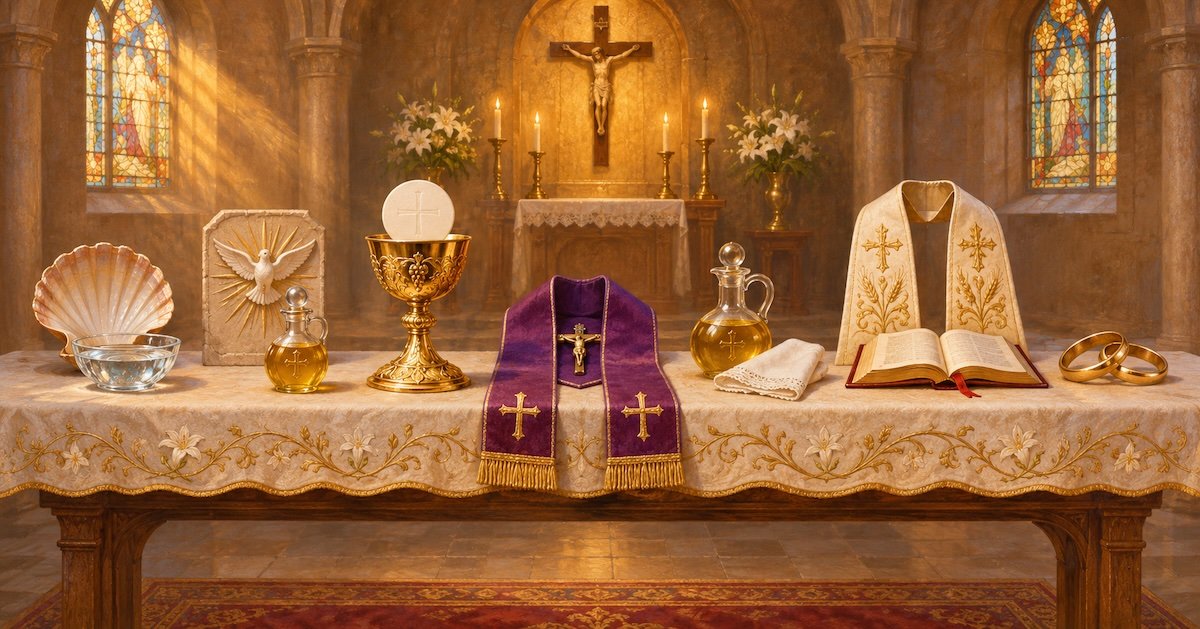
The Catholic Church has seven sacraments: Baptism, Confirmation, the Eucharist, Penance (Confession), the Anointing of the Sick, Holy Orders and Matrimony. They are not just ceremonies: in each of them, Christ himself acts, giving us God's life through visible signs like water, oil, bread and wine.
Here is what a sacrament is, why there are seven, and each one in turn: what it means, what happens, who can receive it, and how often.
What is a sacrament?
The Catechism of the Catholic Church gives a short definition worth knowing by heart:
"The sacraments are efficacious signs of grace, instituted by Christ and entrusted to the Church, by which divine life is dispensed to us." (Catechism of the Catholic Church, 1131)
Piece by piece:
- Signs: things you can see, hear and touch: water, oil, bread, words. God made us with bodies, and he reaches us through our senses.
- Efficacious: they do what they say. A road sign shows you the town; it does not take you there. The water of Baptism does not only show washing, it really washes the soul.
- Of grace: grace is God's life and friendship, freely given. We cannot earn it; we can only receive it.
- Instituted by Christ and entrusted to the Church: they come from Jesus, not from human invention, and the Church celebrates them in his name.
A sacrament does not depend on how holy the priest is: it is Christ who acts (see Catechism, 1127-1128). But the fruit we draw from it depends on our own heart. A gift has to be opened.
⛪ Follow every part of the Mass, the greatest of the sacraments, in Catho+ →
Why seven?
The Church has long taught that there are seven sacraments, all instituted by Christ (see Catechism, 1113-1114). Following Saint Thomas Aquinas, the Catechism explains that they touch all the stages and all the important moments of Christian life, like the stages of natural life (see Catechism, 1210).
We are born, we grow, we eat, we need healing, we give our life to others. The seven sacraments accompany each of those moments.
The three groups of sacraments
The Catechism arranges the seven in three families (see Catechism, 1211):
- Christian initiation: Baptism, Confirmation and the Eucharist. We are born anew, strengthened, and fed (see Catechism, 1212).
- Healing: Penance and the Anointing of the Sick.
- Service of communion: Holy Orders and Matrimony, directed towards the salvation of others (see Catechism, 1534).
Among them all, the Eucharist holds a unique place. The Catechism calls it the "Sacrament of sacraments": all the others lead to it (see Catechism, 1211).
The sacraments of Christian initiation
1. Baptism: the door
Baptism is the first sacrament, the door to all the others (see Catechism, 1213). It frees us from sin, original sin and all personal sins, and makes us children of God and members of the Church (see Catechism, 1263-1265).
- The sign: water, poured three times over the head or by immersion, with the words: "N., I baptize you in the name of the Father, and of the Son, and of the Holy Spirit" (see Catechism, 1239-1240).
- Who can receive it: every person not yet baptized, adult or child (see Catechism, 1246). The Church encourages parents to have their children baptized soon after birth (see Catechism, 1250).
- How often: only once in a lifetime.
Usually a priest or deacon baptizes. But in case of necessity, anyone can baptize by pouring water on the head and saying those words, intending to do what the Church does (see Catechism, 1256 and 1284).
Baptism also unites Catholics with other Christians: those properly baptized in other communities are incorporated into Christ and are our brothers and sisters (see Catechism, 1271). More in our guide on Catholics and other Christians.
2. Confirmation: the strength of the Spirit
Confirmation completes the grace of Baptism. It gives the full outpouring of the Holy Spirit, as at Pentecost, and strengthens us to witness to Christ (see Catechism, 1285 and 1302-1303).
- The sign: anointing with sacred chrism (a perfumed oil blessed by the bishop) on the forehead, with the laying on of the hand and the words: "Be sealed with the Gift of the Holy Spirit" (see Catechism, 1300).
- Who can receive it: every baptized person not yet confirmed (see Catechism, 1306). The minister is normally the bishop (see Catechism, 1312).
- How often: only once.
The age varies a lot. In the Eastern Churches, babies receive Baptism, Confirmation and the Eucharist together. In the Latin Church, Confirmation usually comes later: the reference point is the "age of discretion" (see Catechism, 1233 and 1307), but in practice the age differs from one country or diocese to another. Ask your parish what the practice is where you live.
3. The Eucharist: the bread of life
The Eucharist completes Christian initiation (see Catechism, 1322). At Mass, the bread and wine become the Body and Blood of Christ, "the source and summit of the Christian life" (Catechism, 1324).
- The sign: wheat bread and grape wine, over which the priest says the words of Jesus at the Last Supper: "This is my body which will be given up for you... This is the cup of my blood..." (see Catechism, 1412).
- Who can receive it: baptized Catholics who are in the state of grace. Anyone aware of a grave sin should first go to confession (see Catechism, 1415). In the Latin Church, children receive their First Communion once they have reached the age of reason (see Catechism, 1244).
- How often: as often as you take part in Mass, even daily (see Catechism, 1388-1389). The minimum the Church asks is once a year, if possible during the Easter season (see Catechism, 1389).
Before Communion, the Church asks us to fast from food and drink, except water and medicine, for at least one hour; the elderly, the sick and those caring for them are exempt (Code of Canon Law, can. 919).
Mass on Sundays and certain feasts is also a precept of the Church; see our guide to the holy days of obligation.
The sacraments of healing
4. Penance (Confession): the return home
Baptism washes away every sin, but we still fall. In Penance, also called Confession or Reconciliation, God forgives the sins committed after Baptism and reconciles us with him and with the Church (see Catechism, 1422 and 1440). Think of the prodigal son, whose father runs to meet him.
- The sign: the acts of the penitent (sorrow for sin, confessing sins to a priest, and the intention to make amends) and the priest's absolution (see Catechism, 1448 and 1491). The absolution ends with the words: "I absolve you from your sins in the name of the Father, and of the Son and of the Holy Spirit" (see Catechism, 1449).
- Who can receive it: any baptized Catholic. Bishops and priests are the ministers (see Catechism, 1461), and children make their first confession before their First Communion (see Catechism, 1457).
- How often: as often as you need it. The Church asks Catholics to confess serious sins at least once a year, and strongly recommends regular confession even of everyday faults (see Catechism, 1457-1458).
Afraid of what the priest might think? He is bound by the "sacramental seal": he can never reveal or use anything heard in confession, with no exceptions (see Catechism, 1467). Many parishes add confession times before Christmas; see our guide to Advent.
5. The Anointing of the Sick: strength in illness
Here the Church entrusts the sick to Christ, that he may raise them up and save them (see Catechism, 1499). It is not only for the dying, but for anyone beginning to be in danger from illness or old age (see Catechism, 1514).
- The sign: the priest anoints the forehead and hands with blessed oil, praying: "Through this holy anointing may the Lord in his love and mercy help you with the grace of the Holy Spirit. May the Lord who frees you from sin save you and raise you up" (see Catechism, 1513).
- Who can receive it: a seriously ill or frail elderly Catholic who has reached the use of reason (Code of Canon Law, can. 1004). It is fitting before a serious operation (see Catechism, 1515).
- How often: it can be received again if the person recovers and later falls seriously ill, or if the same illness gets worse (see Catechism, 1515).
At the end of life, the Church also offers Holy Communion as viaticum, food for the journey to the Father (see Catechism, 1524). Do not wait for the last moment to call a priest.
The sacraments at the service of communion
6. Holy Orders: shepherds for the Church
Through Holy Orders, the mission Christ entrusted to his Apostles continues until the end of time. It has three degrees: bishop, priest and deacon (see Catechism, 1536).
- The sign: the bishop lays his hands on the head of the one being ordained and says a prayer of consecration asking for the gift of the Holy Spirit (see Catechism, 1573).
- Who can receive it: a baptized man, called by the Church (see Catechism, 1577).
- How often: each degree only once; it can never be repeated or given for a limited time (see Catechism, 1582).
7. Matrimony: a covenant for life
In Matrimony, a man and a woman establish a partnership of the whole of life, ordered to their good and to the gift of children. Between baptized persons, Christ raised this covenant to the dignity of a sacrament (see Catechism, 1601).
- The sign: the exchange of consent, the spouses' "I do", which is what "makes the marriage" (see Catechism, 1626). In the Latin Church, the spouses themselves are the ministers: they give the sacrament to each other before the Church (see Catechism, 1623). In the Eastern Churches, the priest or bishop crowns the bride and groom.
- Who can receive it: a baptized man and woman who are free to marry and freely consent.
- How often: the bond lasts for life. A marriage between baptized persons, once consummated, can be dissolved by no human power, only by death (see Catechism, 1640, and Code of Canon Law, can. 1141).
Which sacraments can be received only once, and why?
Three sacraments can never be repeated: Baptism, Confirmation and Holy Orders. Besides grace, they give what the Church calls a "character" or "seal": a permanent spiritual mark that configures the person to Christ and to the Church (see Catechism, 1121).
Think of a seal pressed into wax: once it is there, it stays. Even serious sin cannot erase the mark of Baptism (see Catechism, 1272). So a baptized person who drifted away and returns is not baptized again: they come home through Confession.
What about Matrimony? It feels like a once-in-a-lifetime sacrament, and for most people it is, but it works differently. Marriage does not leave a character. Instead, the bond it creates lasts as long as both spouses live: a valid, consummated marriage can be dissolved by no human power and by no cause except death (Code of Canon Law, canon 1141). So no one can marry again while their spouse is alive; but a widow or widower is free to marry again in the Church, as Saint Paul already wrote (1 Corinthians 7:39).
How to receive the sacraments in practice
The answer to almost every practical question is: talk to your parish.
- Adults who want to become Catholic enter the catechumenate, a journey of preparation that leads to receiving Baptism, Confirmation and the Eucharist together (see Catechism, 1232-1233).
- Catholics never confirmed, or who never made their First Communion, can prepare at any age.
- Parents wanting their baby baptized, and engaged couples, should contact the parish early; preparation varies by diocese.
- Confession is usually offered at set times; check the schedule or ask a priest.
- For the sick, ask a priest to visit, at home or in hospital.
The sacraments are not prizes for the perfect. They are God's gifts for people on the way, whatever step you are on.
| Find a parish near you in Catho+ |
Catho+ shows you the churches and Mass times near you, so you can find a parish and take the next step.