When Does Advent 2026 Start? Dates, Meaning and How to Live It
Advent 2026 begins on Sunday 29 November 2026 and ends on the evening of Thursday 24 December, when the celebration of Christmas begins. It lasts four Sundays, and with it the Church begins a new liturgical year.
But Advent is much more than a countdown to Christmas. Let us look at when it starts, why it starts then, and above all what it is for.
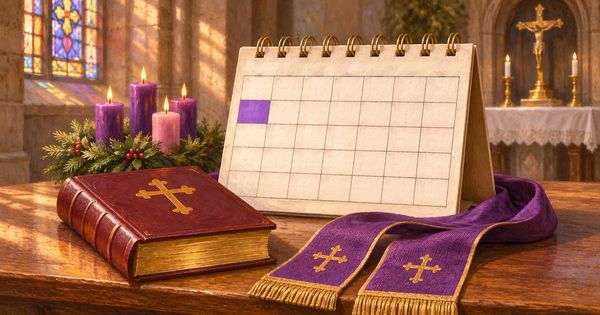
The dates of Advent 2026
- First Sunday of Advent: 29 November 2026
- Second Sunday of Advent: 6 December 2026
- Third Sunday of Advent (Gaudete Sunday): 13 December 2026
- Fourth Sunday of Advent: 20 December 2026
- Christmas Eve: Thursday 24 December 2026
- Christmas Day: Friday 25 December 2026
Along the way, two feasts of Our Lady shine in the middle of Advent: the Immaculate Conception on Tuesday 8 December (a holy day of obligation in many countries; check with your diocese) and Our Lady of Guadalupe on Saturday 12 December.
📅 Follow every day of Advent, with the readings and the saint of the day, in Catho+ →
How the date of Advent is calculated
The rule is simple once you see it: Advent always has four Sundays, and the fourth one is the last Sunday before Christmas. So we count four Sundays back from 25 December.
Another way to say the same thing: the First Sunday of Advent is always the Sunday closest to 30 November, the feast of Saint Andrew. It can fall anywhere between 27 November and 3 December.
Because Christmas moves around the week from one year to the next, Advent changes length. When Christmas falls on a Sunday, Advent lasts a full four weeks (28 days). When Christmas falls on a Monday, the fourth Sunday of Advent is Christmas Eve itself, and Advent is only 22 days long. In 2026, Christmas is on a Friday, so Advent lasts 26 days.
For the years ahead: Advent 2027 begins on 28 November 2027, and Advent 2028 on 3 December 2028.
What does the word "Advent" mean?
"Advent" comes from the Latin adventus, which means "coming" or "arrival". In the ancient world, the word was used for the solemn arrival of an emperor visiting a city: the streets were cleaned, the people dressed in their best and went out to meet him.
Christians borrowed the word for the coming of a far greater King. The question of Advent is therefore very concrete: someone is coming. Are we ready to welcome him?
The three comings of Christ
A beautiful way to understand Advent comes from Saint Bernard of Clairvaux, a monk of the twelfth century. He explained that Advent prepares us for three "comings" of Jesus:
- His coming in the past, in Bethlehem, two thousand years ago, as a little child. This is what we remember at Christmas.
- His coming at the end of time, in glory, "to judge the living and the dead", as we say in the Creed. The first weeks of Advent speak a lot about this, and the Sunday Gospels may surprise you: they talk about watching and staying awake, not about the manger.
- His coming today, quietly, into our hearts: in prayer, in the sacraments, in the Word of God, in the person who needs us.
Advent holds these three together. We remember the first coming, we look forward to the last one, and in between, we open the door to the one who wants to come now.
"When the Church celebrates the liturgy of Advent each year, she makes present this ancient expectancy of the Messiah, for by sharing in the long preparation for the Savior's first coming, the faithful renew their ardent desire for his second coming." (Catechism of the Catholic Church, 524)
The two parts of Advent
Advent is not one block of four weeks. The liturgy divides it into two parts:
- From the First Sunday until 16 December, the readings turn our eyes towards the end of time and the return of Christ. The great figures are the prophet Isaiah and Saint John the Baptist, who call us to prepare the way of the Lord.
- From 17 to 24 December, the Church moves into the immediate preparation for Christmas. The Gospels tell the events that led to the birth of Jesus: the announcement to Mary, Joseph's dream, Mary's visit to Elizabeth. Each evening, the Church prays one of the ancient "O Antiphons", beautiful titles of the Messiah: O Wisdom, O Lord, O Root of Jesse, O Key of David, O Rising Sun, O King of the Nations, O Emmanuel.
Is Advent a time of penance, like Lent?
Yes and no. Both seasons use the color purple, and both invite us to conversion. But the mood is different.
Lent prepares for Easter by walking with Jesus towards his Passion; it is a season of penance. Advent is a season of joyful expectation, like the waiting of a mother for her child. You will notice a few signs of this in the liturgy:
- The Gloria is not sung at Sunday Mass during Advent, so that it can burst out again at Christmas, when the angels sang it over Bethlehem.
- The Alleluia, on the other hand, is still sung, unlike in Lent.
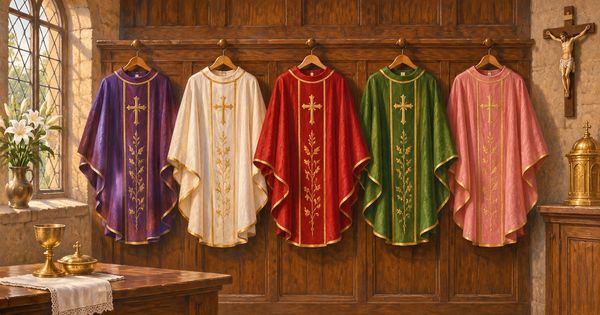
- On the third Sunday, Gaudete Sunday, the priest may wear rose instead of purple: joy is already breaking through. (We explain the colors in our guide to the liturgical colors.)
How to live Advent well
Advent can easily disappear under shopping, parties and end-of-year deadlines. Here are a few simple ways to keep it what it is meant to be:
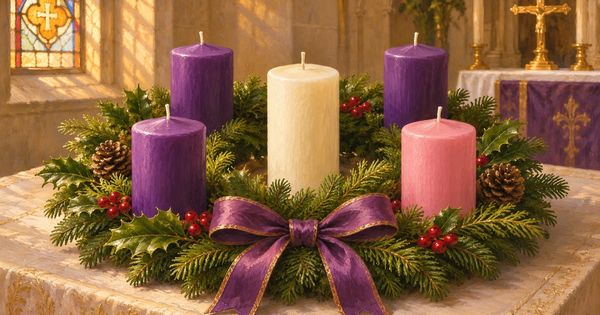
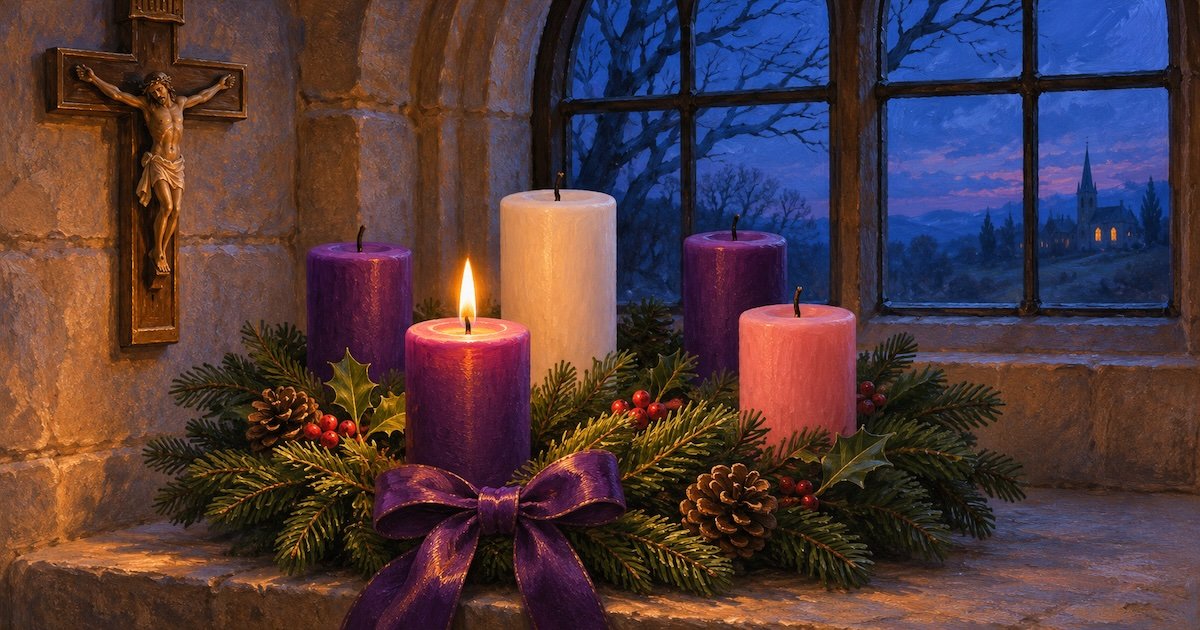
- Light an Advent wreath at home. One more candle each Sunday, with a short prayer. It is one of the easiest and most beautiful family traditions. See our guide to the Advent wreath and the meaning of its candles.
- Go to confession. Many parishes offer a penance service before Christmas. There is no better way to "prepare the way of the Lord" than to clear out what clutters our heart.
- Read the daily Gospel. The Advent readings are some of the most beautiful of the year, especially the prophet Isaiah.
- Pray a little more. Five minutes of silence each morning, a decade of the Rosary with the Joyful Mysteries, which are all about the coming of Jesus.
- Make room for someone. Mary and Joseph found no room at the inn. Who is waiting for a visit, a phone call, a meal from you?
- Wait for Christmas to celebrate Christmas. It is tempting to start the party on 1 December. Try to keep a little of the waiting: the joy of Christmas is greater when we have truly prepared for it. And remember that Christmas is not one day but a whole season, which lasts until the Baptism of the Lord in January.
Advent opens a new liturgical year
The First Sunday of Advent is also the Church's New Year's Day: a new cycle of feasts, seasons and readings begins. In 2026, it opens Year B of the Sunday readings, the year of Saint Mark's Gospel. Learn more in our guide: When does the liturgical year start?
| Follow Advent day by day in Catho+ |
In Catho+, you will find each day of Advent the readings of the day, the saint of the day and the liturgical calendar, so that you can walk towards Christmas one day at a time.