When Does the Liturgical Year Start? The Church's Calendar Explained
The liturgical year starts on the First Sunday of Advent. In 2026, that is Sunday 29 November 2026. While the world waits for 1 January, the Church has already begun her new year about a month earlier.
In this guide, we explain what the liturgical year is, how it is organized, and why it is one of the best tools the Church gives us to grow in faith.
What is the liturgical year?
The liturgical year is the Church's calendar. Instead of following the seasons of nature or the fiscal year, it follows the life of Jesus Christ.
Every year, the Church walks through the great events of our salvation: we wait for the Messiah in Advent, we celebrate his birth at Christmas, we follow him into the desert in Lent, we stand at the foot of the Cross on Good Friday, we rejoice in his Resurrection at Easter, and we receive the Holy Spirit at Pentecost. Then, in Ordinary Time, we listen week after week to his teaching and his miracles.
Think of it like this: a family looks at the same photo album every year, and each time, the children understand a little more of the story. The liturgical year is the Church's family album. It does not just help us remember what Jesus did; the Church teaches that in the liturgy, these mysteries are made present, so that we can live them with him.
"Beginning with the Easter Triduum as its source of light, the new age of the Resurrection fills the whole liturgical year with its brilliance." (Catechism of the Catholic Church, 1168)
📅 See today's season, color and readings in Catho+ →
Why does it start with Advent?
Because every story starts with a waiting. Before Jesus came, God's people waited for the Messiah for centuries, listening to the prophets. Advent places us in that waiting, so that the year can unfold from the promise (Advent), to the birth (Christmas), to the great work of salvation (Lent and Easter), to the life of the Church (Pentecost and Ordinary Time).
The year then ends, quite fittingly, with the Solemnity of Christ the King, the last Sunday before Advent: the story ends where history ends, with Christ reigning over all things.
The seasons of the liturgical year
The liturgical year has five seasons, plus the three holiest days of all, the Triduum. Here they are, with their dates for the year 2026–2027:
- Advent, about four weeks of joyful preparation for Christmas. 29 November to 24 December 2026. Color: violet.
- Christmas season, from the birth of Jesus to his Baptism in the Jordan, including the Holy Family, Mary Mother of God and the Epiphany. 25 December 2026 to 10 January 2027. Color: white.
- Ordinary Time (first part), a few weeks between Christmas and Lent. 11 January to 9 February 2027. Color: green.
- Lent, forty days of prayer, fasting and almsgiving, from Ash Wednesday until Holy Thursday. 10 February to 25 March 2027. Color: violet.
- The Easter Triduum, the summit of the whole year: Holy Thursday evening, Good Friday, Holy Saturday and the Easter Vigil. 25 to 28 March 2027.
- Easter season, fifty days of joy, from Easter Sunday to Pentecost. 28 March to 16 May 2027. Color: white.
- Ordinary Time (second part), the longest stretch of the year, ending with Christ the King. 17 May to 27 November 2027. Color: green.
Then on 28 November 2027, Advent comes again, and a new year begins.
Note that the Epiphany is celebrated on 6 January in some countries and on the Sunday between 2 and 8 January in others (3 January in 2027), and the Ascension on a Thursday (6 May 2027) or on the following Sunday, depending on your country. The dates above follow the most common arrangement.
Why "Ordinary" Time?
"Ordinary" does not mean "boring". It comes from the word "ordinal", as in counted: the Sundays are numbered, the Second Sunday in Ordinary Time, the Third, and so on, up to the Thirty-Fourth.
These green weeks are the time of growth. Just as a plant grows quietly most of the year, between its flowering seasons, Ordinary Time is when we follow Jesus through his public life, hear his parables and let his word take root in us.
Why does Easter move, but Christmas doesn't?
Christmas is fixed: 25 December. Easter follows the moon: it is celebrated on the Sunday after the first full moon of spring, following the ancient link with the Jewish Passover, during which Jesus died and rose again. That is why Easter can fall anywhere between 22 March and 25 April, and with it Ash Wednesday, the Ascension and Pentecost all move too.
Year A, B and C: the cycle of readings
The liturgical year also sets which readings we hear at Mass. To help us hear as much of the Bible as possible, the Church uses a three-year cycle for Sunday readings, each year centered on one of the Gospels:
- Year A: the Gospel of Matthew.
- Year B: the Gospel of Mark. Because Mark is the shortest Gospel, it is completed in the summer by chapter 6 of John, the great "Bread of Life" discourse on the Eucharist.
- Year C: the Gospel of Luke.
The Gospel of John is read every year, especially during Lent and the Easter season.
The liturgical year that begins on 29 November 2026 is Year B. So for a whole year, the Sunday Gospel will mostly come from Saint Mark, the most direct and fast-moving of the four Gospels.
Weekday Masses follow a separate two-year cycle for the first reading: Year I in odd-numbered years and Year II in even-numbered years. The year that begins in Advent 2026 uses Year I, since most of it falls in 2027.
Feasts, memorials and solemnities
Within the seasons, the Church celebrates the saints and the great mysteries of faith. Not all days have the same weight. From the most important to the simplest:
- Solemnities, the greatest feasts, like Christmas, Easter, the Assumption of Mary or All Saints.
- Feasts, like the feasts of the Apostles.
- Memorials, the days of many saints, which can be obligatory or optional.
Some solemnities are also holy days of obligation, when Catholics are asked to attend Mass as on a Sunday. The list varies by country, so check with your diocese.
How to live the liturgical year
- Follow the readings of the day. It is the simplest way to let the liturgical year shape your prayer.
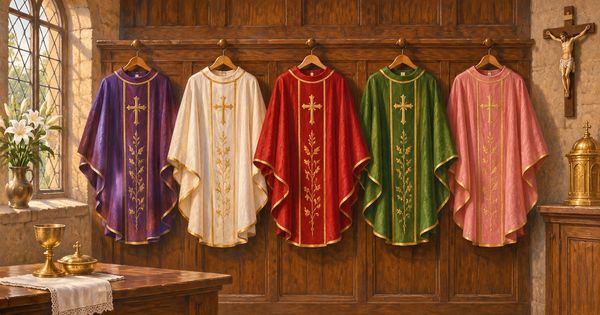
- Notice the colors. At Mass, the color of the priest's vestments tells you where you are in the year. Our guide to the liturgical colors explains each one.
- Bring the seasons home. An Advent wreath, a nativity scene kept until the Baptism of the Lord, a small fast on the Fridays of Lent, flowers for Easter: the liturgical year can become the rhythm of family life.
- Get to know the saints of the day. They are friends who walked the same road before us.
| Open the liturgical calendar in Catho+ |
The Catho+ liturgical calendar shows each day its season, its color, the feast or the saint, and the readings of the Mass, so you always know where you are in the Church's year.
Advent is about to begin: find this year's dates in our guide When does Advent 2026 start?