What Do the Liturgical Colors Mean? Purple, White, Red, Green and Rose
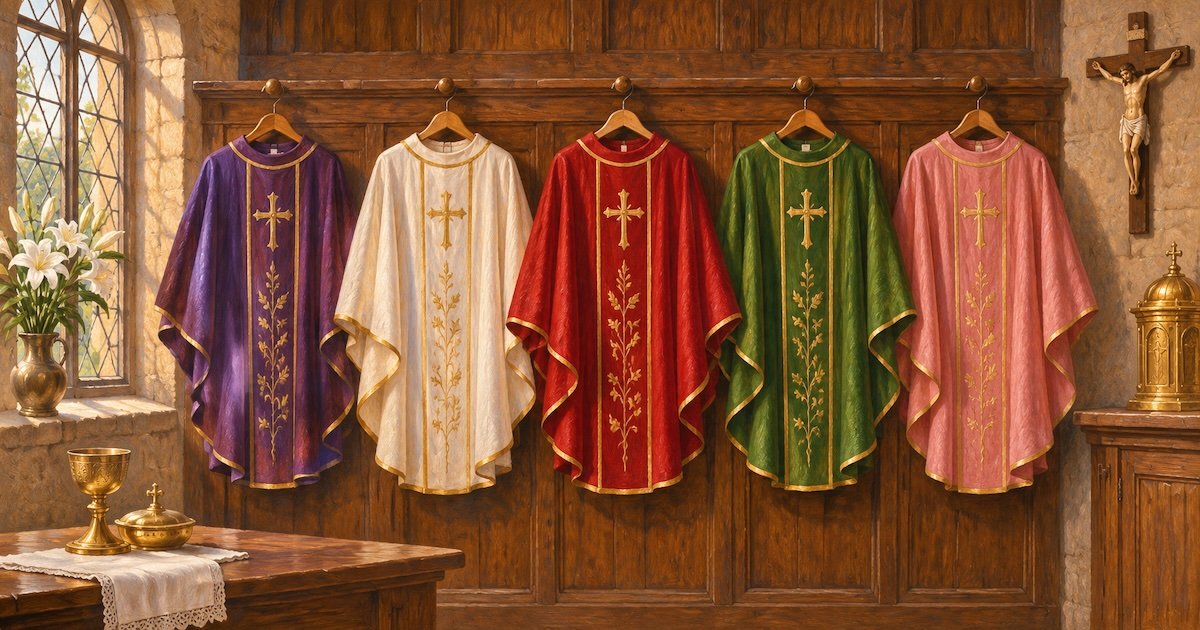
One Sunday the priest wears green, a few weeks later purple, then white, sometimes red, and twice a year even pink. These colors are not a matter of taste or fashion: they follow precise rules, and each one tells you something about the day you are celebrating.
Once you know the code, a glance at the altar tells you where you are in the Church's year. Here is what each color means.
Why does the Church use colors?
We are not pure spirits: we understand with our eyes as well as our ears. The Church has always known this, and she speaks to us through signs, gestures and colors. The colors of the vestments and the altar cloths help us feel, almost without thinking, the spirit of each season: the waiting of Advent, the joy of Easter, the sorrow of Good Friday.
"The purpose of a variety in the color of the sacred vestments is to give effective expression even outwardly to the specific character of the mysteries of faith being celebrated and to a sense of Christian life's passage through the course of the liturgical year." (General Instruction of the Roman Missal, 345)
The color you see is mainly that of the priest's chasuble (the outer vestment he wears at Mass) and his stole, and often of the cloths that decorate the altar and the lectern.
🎨 See the color of every day of the year in Catho+ →
Green: hope and growth
When: Ordinary Time, which is most of the year, between Christmas and Lent and from Pentecost to Advent.
Why: green is the color of growing things. During Ordinary Time, we follow Jesus through his public life and let his word grow in us, quietly, week after week, like a plant in the summer. Green is also the color of hope: life is growing, and the harvest is coming.
Purple (violet): preparation and conversion
When: Advent and Lent. It may also be used at funerals and Masses for the dead.
Why: purple is the color of penance and preparation, of a heart that makes itself ready. But the same color does not carry exactly the same feeling in both seasons:
- In Lent, purple speaks of penance: we fast, we pray more, we turn away from sin as we walk with Jesus towards his Passion.
- In Advent, purple speaks of joyful expectation. It is the waiting of a mother for her child, of a watchman for the dawn. We prepare, but with hope.
You may notice that some parishes use a slightly bluish shade of violet in Advent, to mark this difference. The Roman Missal itself simply speaks of violet for both seasons.
Rose (pink): joy breaking through
When: only twice a year, and it is optional:
- Gaudete Sunday, the Third Sunday of Advent ("Gaudete" means "Rejoice"). In 2026, it falls on 13 December.
- Laetare Sunday, the Fourth Sunday of Lent ("Laetare" also means "Rejoice").
Why: rose is purple with a little white mixed in, as if the light of the coming feast were already shining through. Halfway through a season of preparation, the Church gives us a breath of joy to encourage us: Christmas, or Easter, is near. That is also why the third candle of the Advent wreath is pink.
White (and gold): joy, light and glory
When:
- The Christmas and Easter seasons.
- Feasts of the Lord other than those of his Passion, such as the Epiphany, the Transfiguration or Christ the King.
- Feasts of the Virgin Mary, the angels, and saints who were not martyrs.
- All Saints (1 November), the birth of Saint John the Baptist, Saint John the Evangelist, the Chair of Saint Peter, the Conversion of Saint Paul.
- Often at weddings and baptisms, and it may be used at funerals, as a sign of the Resurrection.
Why: white is the color of light, purity and victory. It recalls the shining garments of the risen Christ and of the angels at the empty tomb, and the white robe given at baptism.
On the most solemn days, the Church allows more precious vestments, often gold or silver, in place of white (and sometimes of other colors). Gold expresses the glory and festivity of the greatest feasts.
Red: the fire of the Spirit and the blood of the martyrs
When:
- Palm Sunday and Good Friday, when we celebrate the Passion of Christ.
- Pentecost.
- The feasts of the Apostles and the Evangelists, and of the martyrs.
- Celebrations of the Holy Cross, and often the sacrament of Confirmation.
Why: red has two meanings, and both are about love. It is the color of blood: the blood Christ shed for us, and the blood of the martyrs who gave their lives for him. And it is the color of fire: the tongues of fire of the Holy Spirit who came down on the Apostles at Pentecost.
Black: mourning and hope
When: where it is the custom, at funerals and Masses for the dead, and on All Souls' Day (2 November).
Why: black expresses mourning and prayer for the dead. It is rarer today, since violet or white are also allowed, but it is still in use. Even black is not despair for Christians: we mourn, but as people who hope in the Resurrection.
What about blue?
Blue is often associated with the Virgin Mary, but it is not one of the liturgical colors of the Roman Rite. Mary's feasts are celebrated in white. The only exception is an old privilege granted to Spain and some places linked to it, which may use blue for the Immaculate Conception.
At a glance
- Green: Ordinary Time. Hope and growth.
- Purple: Advent and Lent. Preparation and conversion.
- Rose: Gaudete and Laetare Sundays. Joy breaking through.
- White or gold: Christmas, Easter, the Lord, Mary, the saints. Light and glory.
- Red: Passion, Pentecost, Apostles and martyrs. The love that gives its life, the fire of the Spirit.
- Black: funerals and All Souls. Mourning in hope.
Want to see how the seasons follow one another? Read our guide When does the liturgical year start?
| See today's color in Catho+ |
The Catho+ liturgical calendar shows the color of every day of the year, with its feast and its readings.