What Is the Difference Between Catholics and Other Christians?
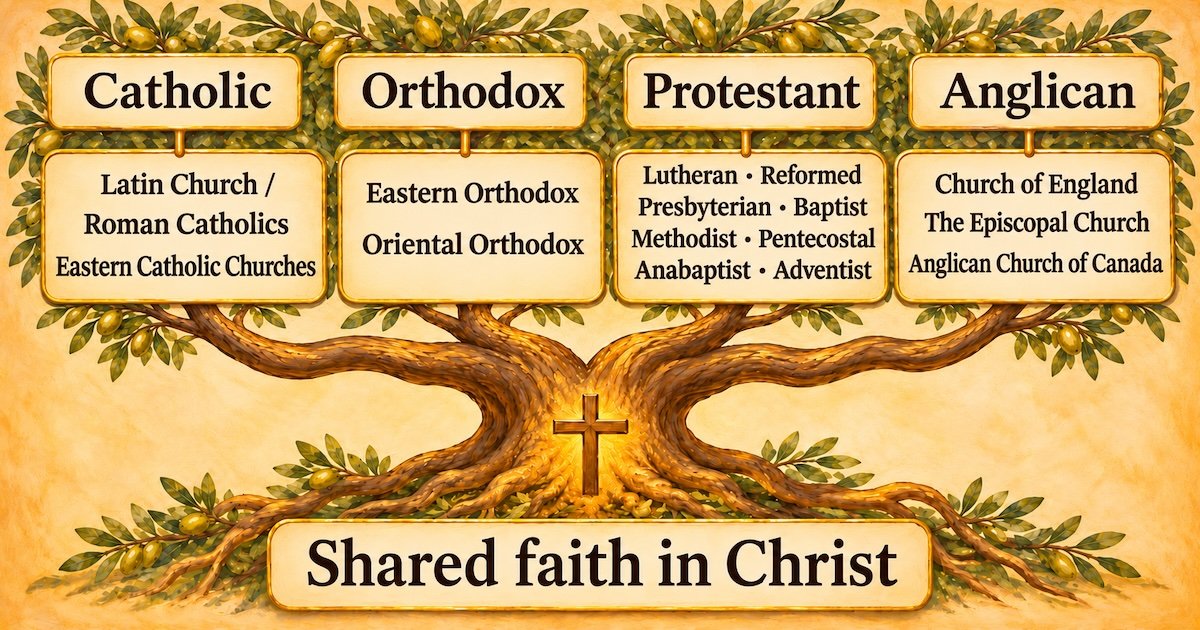
Catholics, Orthodox, Protestants and Anglicans are all Christians: they believe in one God, Father, Son and Holy Spirit, in Jesus Christ as true God and true man, and they are baptized in his name. What separates them is mainly the question of the Church: who has authority to teach, what the sacraments are, and how Scripture and Tradition fit together.
Maybe you have a Protestant friend, an Orthodox neighbor, an Anglican in-law. This guide explains, simply and fairly, what we share, where we differ, and how the Catholic Church looks at other Christians today.
What all Christians share
- One God in three Persons: the Father, the Son and the Holy Spirit.
- Jesus Christ, the Son of God made man, who died for our sins and rose from the dead.
- The Bible as the Word of God.
- Baptism in the name of the Father, and of the Son, and of the Holy Spirit.
- The Our Father, the prayer Jesus himself taught.
Many Christians also profess the same Nicene Creed, written at the Council of Nicaea in 325 and completed at the Council of Constantinople in 381, long before any of the great divisions. In November 2025, for the 1,700th anniversary of that council, Pope Leo XIV and Ecumenical Patriarch Bartholomew prayed together, with other Christian leaders, on the site of ancient Nicaea, in today's Turkey.
For Catholics, baptism is the deepest bond of all. The Catechism says it plainly: "Baptism constitutes the foundation of communion among all Christians", including those who are not in full communion with the Catholic Church (Catechism, 1271). A Lutheran or Baptist friend who was properly baptized is truly your brother or sister in Christ.
📖 Read the Scriptures all Christians share in Catho+ →
The Orthodox Churches
For the first thousand years, the Christians of the East (Greek-speaking, around Constantinople) and of the West (Latin-speaking, around Rome) lived in one Church, with different languages, liturgies and customs. Slowly, through misunderstandings, politics and theological disputes, they drifted apart. The date usually given for the split is 1054, when a legate of the Pope and the Patriarch of Constantinople excommunicated each other. In reality the separation grew over centuries, and those excommunications were lifted in 1965 by Pope Paul VI and Patriarch Athenagoras.
Today the Orthodox Church is a family of self-governing Churches (Greek, Russian, Romanian, Serbian, and others) sharing the same faith and liturgy. The Ecumenical Patriarch of Constantinople is honored among them as first among equals.
The main differences
- The authority of the Pope. The Orthodox honor the Bishop of Rome as the first bishop of the ancient Church, but they do not accept his universal authority over all the Churches. This is the heart of the division.
- The Filioque. The original Creed says the Holy Spirit "proceeds from the Father". In the West, the words "and the Son" (in Latin, filioque) were later added. The Orthodox object both to the addition and to its meaning. The Catechism presents the Eastern and Western ways of speaking as complementary expressions of the same mystery (Catechism, 248).
- Married priests. In the Orthodox Churches, as in all the Eastern tradition, married men can be ordained priests and deacons, while bishops are chosen from among celibates. The Catechism calls this a legitimate practice of long standing (Catechism, 1580).
What Catholics and Orthodox share
An enormous amount: the same apostolic faith, bishops in apostolic succession, true priests, the same sacraments (which the Orthodox call the holy mysteries), the Eucharist as the true Body and Blood of Christ, a deep love for Mary, the Mother of God, and for the saints and icons. The Catholic Church teaches that the Orthodox Churches possess true sacraments, above all the priesthood and the Eucharist (Catechism, 1399). The communion between us is so deep, says the Catechism, "that it lacks little to attain the fullness that would permit a common celebration of the Lord's Eucharist" (Catechism, 838).
There are also ancient Churches of the East, such as the Coptic, Armenian and Ethiopian Churches, called the Oriental Orthodox, which separated even earlier, after the Councils of Ephesus and Chalcedon in the fifth century.
The Eastern Catholic Churches: a common confusion
You may walk into a Catholic church and find icons, incense, a liturgy sung in Ukrainian or Arabic, and a married priest with a family. You are not in an Orthodox church: you are in an Eastern Catholic Church.
There are 23 Eastern Catholic Churches, such as the Ukrainian Greek Catholic, Maronite, Melkite, Chaldean and Syro-Malabar Churches. They are fully Catholic, in full communion with the Pope, but they keep their own rites, spirituality, laws and customs, often very close to those of the Orthodox. Together with the Latin Church, the Church of the Western tradition centered on Rome, they make up the one Catholic Church. Its members, by far the largest group, are the Catholics most people simply call "Roman Catholics". The Church holds all lawfully recognized rites "to be of equal right and dignity" (Catechism, 1203). So a Latin (Roman) Catholic can attend Mass and receive Communion in an Eastern Catholic church, and the reverse: it is the same Church.
The Protestant churches
In 1517, a German monk and professor, Martin Luther, published his 95 Theses against the abuse of indulgences. He wanted to reform the Church, but the dispute led to a lasting break. Other reformers followed, such as John Calvin in Geneva. This movement is called the Reformation, and the Churches born from it are called Protestant.
Protestants are very diverse: Lutherans, Reformed and Presbyterians, Baptists, Methodists, Pentecostals, evangelicals, and many independent churches. Some have bishops and a rich liturgy; others have a simple service centered on preaching. So any summary is a generalization, but most Protestants would recognize these principles:
- Scripture alone (sola scriptura): the Bible is the final authority for faith, above any Church tradition or teaching office.
- Faith alone (sola fide) and grace alone: we are saved by God's free grace, received through faith in Christ, not earned by our works.
- Two sacraments for most: Baptism and the Lord's Supper (Communion), the two clearly instituted by Jesus in the Gospels. Some prefer the word "ordinances".
- The Lord's Supper: views vary widely. Lutherans believe Christ is truly present; many others see it as a memorial of his sacrifice.
- Mary and the saints: Protestants honor Mary as the mother of Jesus and admire the saints as examples, but generally do not pray to them or ask for their intercession.
- The Pope: Protestants do not recognize his authority.
Here too, dialogue has borne fruit. In 1999, the Catholic Church and the Lutheran World Federation signed a Joint Declaration on the Doctrine of Justification, expressing a shared basic understanding of how we are saved by grace through faith in Christ, on the very question that had started the Reformation.
The Anglican Communion
Anglicans came out of the Reformation in England, and they are often counted among the Protestants. They are treated apart here because they kept more of the older Church than most Protestant churches, and many Anglicans do not call themselves Protestant at all.
The Church of England separated from Rome under King Henry VIII. When the Pope would not annul his marriage to Catherine of Aragon, Henry broke with Rome, and the Act of Supremacy of 1534 declared the king supreme head of the Church in England. Over the following decades, the Church of England took on many Reformation ideas while keeping bishops and much of the ancient liturgy.
Today, the Anglican Communion is a worldwide family of Churches (including the Episcopal Church in the United States) that look to the Archbishop of Canterbury as a focus of unity. Many Anglicans describe their tradition as both catholic and reformed. The Second Vatican Council noted that, among the communities born from the Reformation, the Anglican Communion "occupies a special place", because Catholic traditions and institutions partly continue in it (Unitatis Redintegratio, 13).
What makes the Catholic Church distinct
Catholics believe that Christ founded one Church, and that this Church is found in its fullness in the Catholic Church. Here is what Catholics hold most dear:
- Apostolic succession. The apostles left bishops as their successors, and this unbroken line has been handed on by the laying on of hands down to the bishops of today (Catechism, 77 and 861).
- The Pope. The Bishop of Rome, successor of Saint Peter, is the visible source and foundation of unity for the bishops and all the faithful (Catechism, 882).
- The Eucharist. In the Mass, the bread and wine truly become the Body and Blood of Christ: he is present, as the Catechism says, "truly, really, and substantially" (Catechism, 1374). It is the heart of Catholic life, together with the other seven sacraments.
- Scripture and Tradition together. God's Word comes to us through the Bible and through the living Tradition handed down from the apostles, faithfully interpreted by the Church's teaching office. The two are not rivals: they flow from the same source (Catechism, 80 to 82).
Catholics also honor Mary and the saints, asking for their prayers, as we ask a friend to pray for us. That is what we do, for example, in the Rosary.
Because of these differences, Catholics and Protestants do not share Communion at the altar. For the Catholic Church, receiving the Eucharist together is a sign of a unity in faith that is not yet complete (Catechism, 1400). Rules for particular situations exist; if you have a question, ask your priest.
Brothers and sisters in Christ
Catholics are not taught to see other Christians as outsiders or rivals. The Second Vatican Council recognized that, in the old divisions, people on both sides were often to blame, and that those born into other Christian communities cannot be accused of the sin of separation. The Catechism, quoting the Council, says that the Catholic Church accepts them "with respect and affection as brothers" (Catechism, 818).
The Church also recognizes that many elements of holiness and truth are found outside her visible boundaries: the written Word of God, the life of grace, faith, hope and charity, and other gifts of the Holy Spirit. Christ's Spirit uses these Churches and communities as means of salvation (Catechism, 819).
Ecumenism today
The word ecumenism means the movement toward the unity of all Christians. At the Second Vatican Council, the decree Unitatis Redintegratio (1964) declared that the restoration of unity among all Christians is one of its principal concerns.
"The desire to recover the unity of all Christians is a gift of Christ and a call of the Holy Spirit." (Catechism of the Catholic Church, 820)
Unity is not about pretending differences do not exist, or about one side "winning". The Catechism names the path: renewal of the Church, conversion of heart, prayer together, getting to know one another, dialogue, and working together in service of others (Catechism, 821). And it reminds us that full reconciliation is beyond human strength: it is the work of God, resting on the prayer of Christ "that they may all be one".
Every year, many Christians keep a Week of Prayer for Christian Unity, traditionally from 18 to 25 January (in the Southern Hemisphere, often around Pentecost). It is a simple way to start: pray for unity, perhaps with Christians of another Church near you.
Common questions
Is a Protestant baptism valid for Catholics?
Yes, as a rule. A baptism done with water and in the name of the Father, and of the Son, and of the Holy Spirit is recognized by the Catholic Church. A baptized Christian who becomes Catholic is not baptized again.
Is "Roman Catholic" the same as "Catholic"?
Almost. "Roman Catholic" is the everyday name for members of the Latin Church, the Western part of the Catholic Church centered on Rome, which most Catholics in the world belong to. But Eastern Catholics, such as Maronites or Ukrainian Greek Catholics, are fully Catholic too, without being "Roman" in that sense. So every Roman Catholic is Catholic, but not every Catholic is Roman Catholic.
Are Eastern Catholics the same as Orthodox?
No. Their liturgy may look very similar, but Eastern Catholics are in full communion with the Pope; the Orthodox are not.
| Download Catho+ |
Catho+ gives you the Bible, the prayers of the Church and the order of Mass in your pocket, to grow in your Catholic faith day by day.