What Is the Immaculate Conception? Meaning and the December 8 Feast
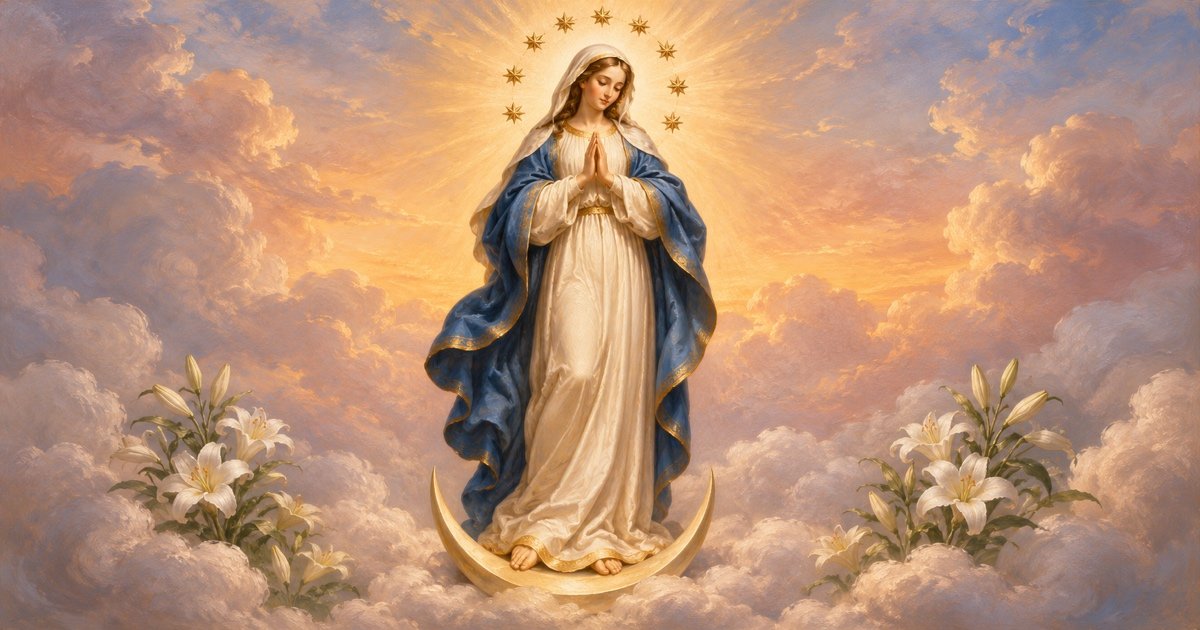
The Immaculate Conception means that Mary, the mother of Jesus, was preserved from original sin from the very first moment of her own conception, by a unique grace of God given through the merits of Christ. The Church celebrates it every year on 8 December, in the middle of Advent.
It is one of the most misunderstood words in the Catholic vocabulary. Many people think it is about the conception of Jesus. It is not. Let us clear that up first, and then see what the feast means and how to celebrate it.
Not the virgin birth: the most common confusion
Two different conceptions are involved here, and it helps to keep them side by side:
- The Immaculate Conception is about Mary's conception. She was conceived naturally, from a father and a mother like every human being (tradition calls them Saint Joachim and Saint Anne). What is extraordinary is not how she was conceived, but that from that first instant her soul was free of original sin. Original sin is not a stain passed on by the act of conception, which is good; it is the loss of original holiness that every human being inherits. Mary was spared that loss by a unique grace, given in view of what Christ would do on the Cross.
- The virginal conception is about Jesus' conception. Jesus was conceived in Mary's womb by the power of the Holy Spirit, without a human father. This is what we celebrate at the Annunciation (25 March) and what the Creed means by "conceived by the Holy Spirit, born of the Virgin Mary" (see Catechism, 496).
A simple way to remember it: the feast of 8 December falls exactly nine months before 8 September, the feast of the Nativity of Mary. It is Mary's beginning we celebrate, not Jesus'. The Gospel read at Mass that day is the Annunciation, which adds to the confusion; it is chosen because it shows us who Mary is, the one the angel greets as "full of grace".
📅 See the Immaculate Conception and every feast of Advent, with the readings of the day, in Catho+ →
What the Church teaches
To understand the Immaculate Conception, start with original sin. Since the fall of Adam and Eve, every human being comes into the world wounded, deprived of the original holiness God intended for us. It is not a personal fault we committed; it is more like a family inheritance we receive. Baptism washes it away.
Mary received the same human nature as all of us, but God made one exception. Because she was to become the mother of his Son, he preserved her from that inheritance from the start. Think of two people saved from a deep pit: one is pulled out after falling in, the other is caught before she falls. Both are saved by the same rescuer. Mary is the one caught before the fall.
This is the key point: Mary is not saved apart from Jesus. She too needed a Savior, and she was redeemed by Christ, only in a more wonderful way, in advance. The Catechism puts it this way, quoting the definition of 1854:
"The most Blessed Virgin Mary was, from the first moment of her conception, by a singular grace and privilege of almighty God and by virtue of the merits of Jesus Christ, Saviour of the human race, preserved immune from all stain of original sin." (Catechism of the Catholic Church, 491)
The paragraphs around it are worth reading slowly (Catechism, 490 to 493). They explain that Mary was prepared by God's grace so that she could give the free "yes" of her faith at the Annunciation; that her holiness "comes wholly from Christ"; and that, by the grace of God, she remained free of every personal sin her whole life long. The Eastern Churches express the same faith when they call her Panagia, "the All-Holy".
Why does it matter?
It is not just a privilege for Mary; it is good news for us. In Mary, we see what God wants to do for every one of us: to make us holy, free from sin, fully alive. What she received at the start, we receive through Baptism and will receive fully in heaven. She is, in a sense, the first fruit of what Jesus came to do.
A dogma defined in 1854
Christians had pondered Mary's holiness for centuries, and the feast of her conception was celebrated long before it became a dogma. Theologians long debated one question: how could Mary be free of sin and still be redeemed by Christ? The answer came to be that she was preserved in view of the merits of her Son.
On 8 December 1854, Blessed Pius IX solemnly defined the Immaculate Conception as a dogma of the faith, in the apostolic constitution Ineffabilis Deus. A dogma is a truth the Church teaches as revealed by God, which Catholics are asked to believe. The wording of his definition is the one quoted above in the Catechism.
Lourdes: "I am the Immaculate Conception"
Just four years later, something happened that Catholics have always seen as heaven's own confirmation. In 1858, in the small town of Lourdes in southern France, a poor and barely educated girl of fourteen, Bernadette Soubirous, saw a beautiful Lady in a grotto by the river, eighteen times between February and July.
For weeks, nobody knew who the Lady was. On 25 March 1858, the feast of the Annunciation, during the sixteenth apparition, Bernadette asked her name once more. The Lady joined her hands, raised her eyes to heaven and answered in the local dialect: "Que soy era Immaculada Councepciou", "I am the Immaculate Conception."
Bernadette did not understand the words. She repeated them all the way to the presbytery so as not to forget them, and told them to the parish priest, Father Peyramale. He, who knew the theology, was deeply moved: he now knew who the Lady was. The Church celebrates Our Lady of Lourdes on 11 February, the date of the first apparition (see Our Lady of Lourdes).
The feast on 8 December
The Solemnity of the Immaculate Conception falls on 8 December, in the heart of Advent. That is no accident of the calendar. Advent is the season of waiting for the Savior, and no one waited for him better than Mary. Before preparing our hearts for Christmas, the Church shows us the heart God himself prepared for his Son. (More on the season in our guide When does Advent start?)
- Rank: it is a solemnity, the highest rank of feast. The Gloria is sung at Mass, even though it is Advent.
- Color: the priest wears white, the color of Marian feasts, instead of the purple of Advent. In Spain, and in some places once linked to the Spanish crown, a privilege dating from the nineteenth century allows blue vestments on this feast. (See our guide to the liturgical colors.)
- When 8 December falls on a Sunday: the Sunday of Advent takes precedence, and the solemnity is moved to Monday 9 December. This happened in 2024.
Is it a holy day of obligation?
In many countries, yes, but the rule depends on where you live: each bishops' conference decides which holy days are kept as days of obligation.
- In the United States, the Immaculate Conception is a holy day of obligation: Catholics are asked to attend Mass that day. Unlike some other holy days, the obligation is kept even when 8 December falls on a Saturday or a Monday. When the feast was moved to Monday 9 December in 2024, the Holy See clarified that the obligation moves with it.
- In the Philippines, it is one of the holy days of obligation, and 8 December is also a special non-working holiday across the country.
- Elsewhere, check with your diocese or your bishops' conference. In some countries it is a day of obligation and even a public holiday; in others it is not.
Patroness of the United States and the Philippines
The Immaculate Conception is close to the heart of two countries in particular:
- The United States: in 1846, the American bishops, gathered in Baltimore, chose Mary under the title of the Immaculate Conception as patroness of the United States, and Pius IX approved it the following year. That is why the great national shrine in Washington is the Basilica of the National Shrine of the Immaculate Conception.
- The Philippines: in 1942, Pope Pius XII proclaimed Mary, under the same title, the principal patroness of the Philippines, at the request of the Filipino bishops. Saint Pudentiana and Saint Rose of Lima remain secondary patronesses.
Curious about patron saints in general, and how to find your own? Read our guide to patron saints.
How to celebrate the Immaculate Conception
- Go to Mass. Where it is a day of obligation, it is the heart of the feast; where it is not, it is still the best way to honor Mary. Many parishes add evening Masses for people coming from work.
- Pray the Rosary. The Joyful Mysteries fit the day perfectly, since the first one is the Annunciation, the Gospel of the feast. If you are new to it, our guide How to pray the Rosary walks you through it step by step.
- Pray a prayer to Mary. The Hail Mary itself begins with the angel's greeting, "full of grace": a perfect prayer for the day. The Hail, Holy Queen and the Memorare are two other classics.
- Visit an image of Mary. Bring flowers or light a candle before a statue of Our Lady in your church or at home, and entrust to her the people you love.
- Learn more about the feast. Read the page on the Immaculate Conception in our saints calendar, and tell your children the story of Bernadette at Lourdes.
- Go to confession. On the feast of the one who was free from all sin, there is no better gift than to let God free us from ours. Advent is a perfect time for it.
The Memorare
Remember, O most gracious Virgin Mary, that never was it known that anyone who fled to thy protection, implored thy help, or sought thy intercession was left unaided. Inspired by this confidence, I fly unto thee, O Virgin of virgins, my Mother. To thee do I come, before thee I stand, sinful and sorrowful. O Mother of the Word Incarnate, despise not my petitions, but in thy mercy hear and answer me. Amen.
You can also pray it, along with the Hail, Holy Queen, in the app: the Memorare in Catho+. And if you would like to prepare for the feast over several days, the Novena to Our Lady is prayed for nine consecutive days: begin on 29 November to end on the eve of the feast. New to novenas? Our guide How to pray a novena explains, step by step.
Four days later, Advent brings another feast of Mary: Our Lady of Guadalupe, on 12 December.
| Pray the Rosary with Mary in Catho+ |
Catho+ guides you through the Rosary bead by bead and gathers prayers to Mary like the Memorare, the Hail, Holy Queen and the Novena to Our Lady, to help you celebrate her feasts all year long.