Our Lady of Guadalupe: The Story and the December 12 Feast
Our Lady of Guadalupe is the title given to the Virgin Mary as she appeared in December 1531 on Tepeyac hill, in what is now Mexico City, to an Indigenous man named Juan Diego. As a sign for the bishop, she left her image on his cloak, the tilma, which is still kept and venerated today. Her feast is celebrated on 12 December, and Saint John Paul II invoked her as Patroness of all America.
Below: the story of the apparitions, what the image shows, who Saint Juan Diego was, how the feast is kept, and how to pray to her.
The story of Guadalupe, day by day
The main written account is the Nican Mopohua, a sixteenth-century text in Nahuatl, the language of the Aztecs, attributed to the Indigenous scholar Antonio Valeriano. The Basilica of Guadalupe tells the story in five apparitions, over four days.
Saturday 9 December 1531: the first request
Early in the morning, Juan Diego is walking to Mass when he hears birdsong on the hill of Tepeyac and someone calling him by name. At the top, he meets a young woman. She tells him that she is the ever-Virgin Holy Mary, and she asks for a little church to be built there, where she will listen to people and heal their sorrows. She sends him to the bishop of Mexico, the Franciscan Juan de Zumárraga.
The bishop receives him kindly but does not believe him. That evening, Juan Diego goes back up the hill and begs the Lady to send someone more important. She answers that he is the one she has chosen, and asks him to try again.
Sunday 10 December: the bishop asks for a sign
Juan Diego sees the bishop a second time. Zumárraga listens more carefully, but asks for a sign. In the afternoon, the Lady promises Juan Diego that he will receive one the next day.
But the next day, Juan Diego does not come. His uncle, Juan Bernardino, has fallen gravely ill, and Juan Diego stays to look after him.
Tuesday 12 December: the roses and the image
Before dawn, his uncle seems close to death, and Juan Diego sets off to fetch a priest. Ashamed of having missed his appointment, he takes another path around the hill to avoid the Lady. She comes to meet him anyway. She tells him not to worry: his uncle is already healed. Then she sends him to the top of the hill to pick flowers.
It is December, on a rocky hilltop, and yet Juan Diego finds flowers there. He gathers them in his tilma and carries them to the bishop. At the same time, according to the account, she appears to Juan Bernardino at home, cures him, and asks that her image be called Holy Mary of Guadalupe. This is where the name comes from.
Around midday, in front of Zumárraga, Juan Diego opens his tilma. The flowers fall to the ground, and on the rough cloth appears the image of the Virgin. Vatican News notes that the bishop recognized the flowers as Castilian roses, which were not found in Mexico. The bishop believes, and the little church is built.
🌹 Entrust your intentions to Mary with the Memorare in Catho+ →
What the image shows
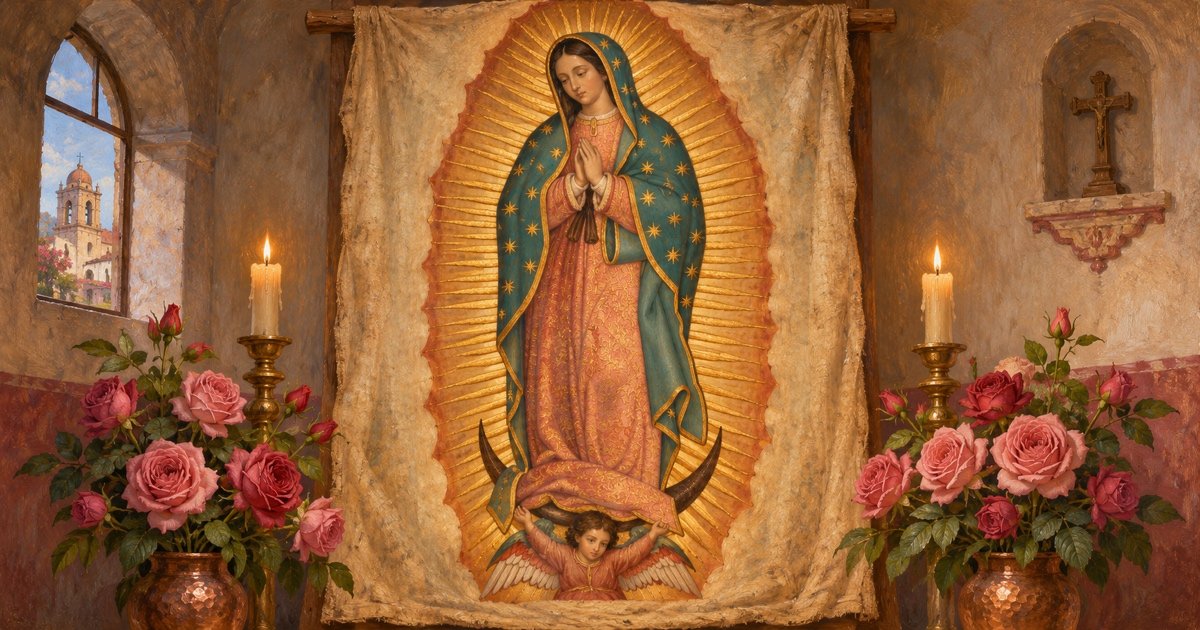
The tilma is a simple cloak of coarse plant fiber, the everyday garment of a poor man. On it, the image shows:
- A young woman with Indigenous features and dress, her head gently bowed and her hands joined in prayer.
- A blue mantle covered with gold stars.
- The moon beneath her feet, and an angel holding her up.
- A black sash around her waist, which the Vatican's biography of Juan Diego reads as a sign that she is expecting a child.
That last detail is the heart of the image. Mary is not the center: she is praying, and she is carrying Jesus. She comes to bring her Son to a new people.
Why it spoke to the Indigenous people
Ten years after the fall of the Aztec capital, the Indigenous peoples of Mexico had seen their world collapse. And the Mother of God came, not to a Spanish nobleman, but to one of them. She spoke to him in his own language, called him with great tenderness, and showed herself with a face like theirs.
Saint John Paul II spoke of the mestiza face of the Virgin of Tepeyac, a face that belongs to both peoples, Indigenous and European. In his letter Ecclesia in America (1999), he called the Guadalupe event a great example of the Gospel being perfectly inculturated: announced in a way a people could recognize as their own (see Ecclesia in America, 11). He saw in Guadalupe the starting point of the evangelization of the whole continent, far beyond Mexico.
What the Church asks us to believe
Guadalupe is what the Church calls a private revelation. Catholics are not required to believe in any apparition the way they believe in the Creed: everything we need for salvation has already been given in Jesus Christ. Approved apparitions are a help to live that faith more fully in a particular time and place (see Catechism, 67).
That said, few apparitions have been honored so highly. The Church gave Guadalupe a feast with its own Mass, popes have prayed before the tilma, and the man who saw her was declared a saint. You can love Our Lady of Guadalupe with full confidence: the Church has approved and encouraged this devotion for centuries.
Saint Juan Diego
His Nahuatl name was Cuauhtlatoatzin, "the talking eagle". Born in 1474, he was baptized as an adult, at about fifty. He was a humble man: in the account, he asks the Lady to send someone more important, and she insists that she has chosen him.
After the apparitions, with the bishop's permission, he went to live as a hermit next to the chapel that housed the image. He looked after the church and welcomed the first pilgrims until his death in 1548, and he was buried in that first chapel.
Saint John Paul II beatified him in 1990, and canonized him on 31 July 2002 in the Basilica of Guadalupe, calling him the first Indigenous saint of the American continent. His feast is on 9 December, the day of the first apparition (in the United States, an optional memorial). Read more on his page: Saint Juan Diego Cuauhtlatoatzin.
The Basilica and its pilgrims
The tilma is kept today in the Basilica of Our Lady of Guadalupe, at the foot of Tepeyac hill in Mexico City, on the place where the little church was first asked for. It is one of the most visited Catholic shrines in the world: Vatican News reports that over 20 million people visit each year.
The busiest days are around 12 December. In 2025, Mexico City authorities counted close to 13 million pilgrims in the days around the feast. (Why "basilica"? Our guide explains the difference between a cathedral, a basilica and a church.)
Her titles and patronage
- Patroness of the Americas. In Ecclesia in America (1999), Saint John Paul II invoked Holy Mary of Guadalupe as Patroness of all America and Star of the first and new evangelization, and asked that her feast be celebrated on 12 December throughout the continent.
- Mexico. She is honored as the patroness and Queen of Mexico. In 1754, Pope Benedict XIV approved a Mass and Office for her feast on 12 December.
- The Philippines. According to the Philippine bishops (CBCP), Pope Pius XI declared her Celestial Patroness of the Philippines in 1935. The CBCP also made 12 December an obligatory memorial in the Philippines (2001) and named her Pro-Life Patroness of the Philippines (2002). (The principal patroness of the Philippines is Mary under another title, the Immaculate Conception.)
For how patronages work, and which were declared by a pope, see our guide to patron saints, or visit her page: Our Lady of Guadalupe.
The feast on 12 December
12 December is the anniversary of the day the image appeared on the tilma. The way the feast is ranked depends on the country:
- In the United States, it is a feast, with its own readings. When 12 December falls on a Sunday of Advent, the Sunday takes precedence.
- In Mexico, it is a solemnity, the highest rank of celebration.
- In the Philippines, it is an obligatory memorial.
Elsewhere, check your diocese's calendar. Note that the feast always falls during Advent, four days after the Immaculate Conception (8 December). It fits the season perfectly: the image shows Mary waiting for her child, just as the Church waits for Christmas. See when Advent starts.
How people celebrate
- Las Mañanitas. At midnight, as 11 December turns into 12 December, crowds at the Basilica sing Las Mañanitas, the traditional Mexican birthday song, to the Virgin, followed by Mass.
- Pilgrimages. To the Basilica in Mexico City, and to the many shrines and parishes dedicated to Our Lady of Guadalupe around the world.
- Mass on the feast. The simplest way to honor her is to go to Mass on 12 December. You can find a church and Mass times near you in Catho+.
- Then, the nine days before Christmas. Four days after the feast, on 16 December, Mexico begins the nine evenings of Las Posadas, and the Philippines the nine Masses of Simbang Gabi.
How to pray to Our Lady of Guadalupe
There is no special formula required. Speak to her as Juan Diego did: simply, with your worries and the people you love, like his sick uncle. And then trust. Here are four ways to begin.
The Rosary
With Mary, look at the life of Jesus. In Advent, the Joyful Mysteries fit especially well: the Annunciation, the Visitation, the Nativity. A single decade is already a real prayer. Our guide shows you how to pray the Rosary, step by step.
The Memorare
A short, ancient prayer of trust, perfect for asking Mary's help:
Remember, O most gracious Virgin Mary, that never was it known that anyone who fled to thy protection, implored thy help, or sought thy intercession was left unaided. Inspired by this confidence, I fly unto thee, O Virgin of virgins, my Mother. To thee do I come, before thee I stand, sinful and sorrowful. O Mother of the Word Incarnate, despise not my petitions, but in thy mercy hear and answer me. Amen.
The Hail, Holy Queen
The prayer that closes the Rosary, calling Mary "Mother of mercy" and asking her to show us Jesus. You will find it in the app: Hail Holy Queen.
A novena
Many people prepare for the feast with nine days of prayer, from 3 to 11 December, ending on the eve of 12 December. You can pray the Novena to Our Lady in Catho+, and our guide How to pray a novena explains, step by step.
| Pray the Rosary with Mary in Catho+ |
Catho+ guides you bead by bead through the Rosary, and gathers the Marian prayers, from the Memorare to the Hail, Holy Queen, so you can honor Our Lady of Guadalupe every day, not only on 12 December.