What Is a Novena and How Do You Pray One?
A novena is a prayer prayed for nine days in a row, usually for a particular intention or to prepare for a feast. The word comes from the Latin novem, "nine". There is nothing complicated about it: you choose a prayer, you choose an intention, and you come back to God with it every day for nine days.
This guide explains where the novena comes from, the different kinds of novenas, how to pray one step by step, and the novenas you can pray today in Catho+.
Where does the novena come from?
The first "novena" is in the Bible. After Jesus ascended into heaven, he told his disciples to wait in Jerusalem until they received the Holy Spirit. So they went back to the upper room and waited. Saint Luke tells us that they all devoted themselves to prayer together, with some women, with Mary the mother of Jesus, and with his brothers (Acts 1:12-14). Then, on the day of Pentecost, the Holy Spirit came upon them (Acts 2:1-4).
That is the heart of every novena: persevering, trusting prayer while we wait for God to act. The disciples did not know exactly what was coming. They simply stayed together, stayed with Mary, and kept praying. The Church's Directory on Popular Piety and the Liturgy (2001) traces the Pentecost novena to exactly this scene, the days of shared prayer between the Ascension and Pentecost (Directory, 155).
🕊️ Pray the Novena to the Holy Spirit, and six other novenas, in Catho+ →
The different kinds of novenas
All novenas last nine days, but they do not all have the same purpose. There are three main families.
Novenas to prepare for a feast
Just as we get ready for a big family celebration, the Church often gets ready for a great feast with nine days of prayer. The Directory on Popular Piety notes that a feast day is often preceded by a triduum (three days), a septenary (seven days) or a novena, and that these are truly a preparation for the feasts of Our Lady (Directory, 189).
- The Pentecost novena is the oldest model of all. In 1897, Pope Leo XIII, in his encyclical on the Holy Spirit, Divinum Illud Munus, asked that a novena be held before Pentecost in all parish churches, every year (no. 13).
- The Christmas novena, in the nine days before Christmas: more on it below.
- Novenas before a saint's feast: many people pray a novena to Saint Joseph that ends on 19 March, to Saint Anthony ending on 13 June, to Saint Michael the Archangel ending on 29 September, to Saint Thérèse ending on 1 October, or to Saint Jude ending on 28 October.
- Novenas before a Marian feast: the novena to the Immaculate Conception is prayed from 29 November to 7 December (see our guide What is the Immaculate Conception?), and the novena to Our Lady of Guadalupe from 3 to 11 December (see Our Lady of Guadalupe).
Novenas of petition
This is the most common kind today. You have a need, small or large: a job, a sick friend, a difficult decision, a child far from the faith. You bring it to God for nine days, often asking a saint to pray with you and for you. Asking the saints to intercede is like asking a friend to pray for you, except that these friends are already with God.
Novenas for the dead
Praying for nine days for someone who has died is an ancient custom. The Church still keeps it at the highest level: when a pope dies, the cardinals celebrate funeral rites for the repose of his soul for nine consecutive days (John Paul II, Universi Dominici Gregis, 27). Many families do the same, more simply, for someone they love.
A special case: perpetual novenas
Some novenas are not prayed for nine days in a row but on one day each week, again and again, in a parish or at a shrine. They are called "perpetual novenas". The best known is the novena to Our Lady of Perpetual Help, prayed every Wednesday: in the Philippines, it draws huge crowds to the Baclaran shrine in Manila each week. Another is the novena to Our Lady of the Miraculous Medal, prayed on Mondays.
The Christmas novena
The nine days before Christmas are, in many countries, the best-loved novena of the year. The Church's Directory on Popular Piety suggests praying it with Evening Prayer from 17 to 23 December, with the great "O Antiphons" that call on Christ by his biblical names: Wisdom, Root of Jesse, Key of David, Rising Dawn, Emmanuel (Directory, 103). It is the last stretch of Advent: the waiting becomes more intense, and the novena helps us make room for the One who is coming. (More on the season in our guide When does Advent start?)
In some countries, the Christmas novena has become a great popular tradition:
- In the Philippines, Simbang Gabi: nine Masses, at dawn or in the evening, from 16 to 24 December. The last one, on Christmas Eve, is the Misa de Gallo.
- In Mexico and much of Latin America, Las Posadas: nine evenings, from 16 to 24 December, recalling Mary and Joseph's search for a place to stay in Bethlehem. Neighbors walk in procession, sing at a door to ask for shelter, pray together, often the Rosary, and end with a celebration.
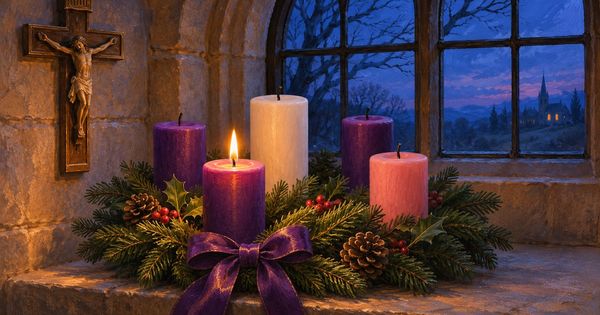
Wherever you live, you can keep it simply at home: pick a time each evening from 16 or 17 December, light a candle, read the Gospel of the day and pray a novena to Our Lady, who waited for Jesus like no one else.
How to pray a novena, step by step
- Choose your intention. Be concrete and honest. You can bring one intention or several. It is also fine to pray simply to grow closer to God, or to prepare your heart for a feast.
- Choose your novena. Pick a prayer that fits your intention: a novena to the Holy Spirit before an important decision, to Saint Joseph for your family or your work, to Saint Anthony when something (or someone) is lost. The choices in Catho+ are described below.
- Choose a time. Nine days in a row is easier with a fixed moment: in the morning with coffee, at lunch, before bed. Many novenas take only five minutes.
- Pray the same prayer each day. Begin with the Sign of the Cross, recall your intention in your own words, then pray the novena prayer slowly. Many people add an Our Father, a Hail Mary and a Glory Be.
- Listen as well as speak. Leave a minute of silence. A novena is a conversation, not a recording.
- On the ninth day, give thanks, whatever has happened. And if you can, finish your novena with confession or Mass: the Directory says these devotions bear their best fruit when they lead to the sacraments of Penance and the Eucharist (Directory, 189). See our guide to the seven sacraments.
What if I miss a day?
Simply pick up where you left off, or add the missed day at the end. Do not panic, and do not feel you have "broken" anything. God is not a vending machine that jams when a coin is missing. He is a Father who is glad every time you come back.
Of course, faithfulness matters: coming back day after day, even when we do not feel like it, is part of the gift we offer. But it is faithfulness of the heart, not a technical rule.
A novena is not a magic formula
This is the most important point of all. You may come across "novenas that never fail", chain prayers that must be copied a certain number of times, or promises that your wish will be granted on the ninth day. Be wary of them.
The Catechism is clear: attributing the power of prayers to their mere outward performance, apart from the interior dispositions they require, is to fall into superstition (Catechism, 2111). The number nine has no power of its own. What matters is the faith, the trust and the love with which we pray.
So what does a novena "do"? It changes us first. Nine days of returning to God with the same need teach us patience, humility and trust. Often the answer is not the one we expected. Sometimes it is "yes", sometimes "not yet", sometimes "I have something better for you". Like the disciples in the upper room, we pray with Mary and leave the outcome to God: "thy will be done".
The novenas in Catho+
Catho+ offers seven novenas. Each one has a main prayer and a short daily prayer, with a place to state your intention. Here is what each one is about.
- Novena to the Holy Spirit: traditionally prayed between the Ascension and Pentecost, in the footsteps of the disciples. It opens with the classic "Come, Holy Spirit" and asks for the gifts of wisdom and understanding. It is also a good prayer at any time of the year, before an important choice or a sacrament such as Confirmation.
- Novena to Our Lady: addressed to Mary as Queen of the most holy Rosary, recalling her appearances to the children of Fatima. It asks for a love of the Rosary and for graces through the merits of Jesus. A natural companion to the Rosary.
- Novena to the Sacred Heart: an offering of your heart to the Heart of Jesus, asking to be humble, patient and pure, and to be protected and comforted. Its daily prayer is a short act of trust: "Sacred Heart of Jesus, I place all my trust in you." Many pray it before the feast of the Sacred Heart, which falls on a Friday, usually in June.
- Novena to St. Anthony: Saint Anthony of Padua, the patron of lost things, known as a wonder-worker. The novena asks him to bring your petition to the Infant Jesus, and ends with the well-known little rhyme for finding something lost.
- Novena to St. Joseph: entrusts all your concerns to the protector of the Holy Family, and asks for his help at the hour of death, as the patron of the dying. Fitting for family needs, work, and before his feast on 19 March.
- Novena to St. Jude: Saint Jude, apostle and martyr, is invoked as the patron of hopeless and difficult cases. This novena is for the moments when you feel there is nothing left to try. Its message: there is always hope.
- Novena to St. Thérèse: Saint Thérèse of Lisieux, the "Little Flower", who promised to spend her heaven doing good on earth. The novena asks her for a "rose" from heaven and for the grace to live her "Little Way" of simple trust, and ends with her short Act of Love.
The Divine Mercy Novena
One more novena deserves a special mention. In her diary, Saint Faustina wrote that Jesus asked for a novena to prepare for the feast of Divine Mercy. It begins on Good Friday and ends on Divine Mercy Sunday, the Sunday after Easter. Each day is offered for a different group of people, starting with all humanity and especially sinners, and the Divine Mercy Chaplet is traditionally prayed each day.
You will find the Divine Mercy Chaplet in Catho+, and our guide How to pray the Divine Mercy Chaplet explains it bead by bead.
Common questions
Can I pray a novena with others?
Yes, and it is beautiful. A family can pray a novena together for a sick grandparent, a parish for its needs, friends for one another. Each person can pray from home at the same time each day.
Can I pray more than one novena at a time?
You can, but there is no need to pile them up. One novena prayed with attention is worth more than three prayed in a hurry.
What if my prayer is not answered?
God always hears. He does not always give what we ask, because he sees further than we do. Keep praying, keep trusting, and look back after a while: you may see the answer was there, in a different form.
| Start a novena in Catho+ |
In Catho+, you will find seven novenas, the Divine Mercy Chaplet and many other prayers, ready to pray wherever you are.