How to Pray the Angelus: Words, Times and Meaning
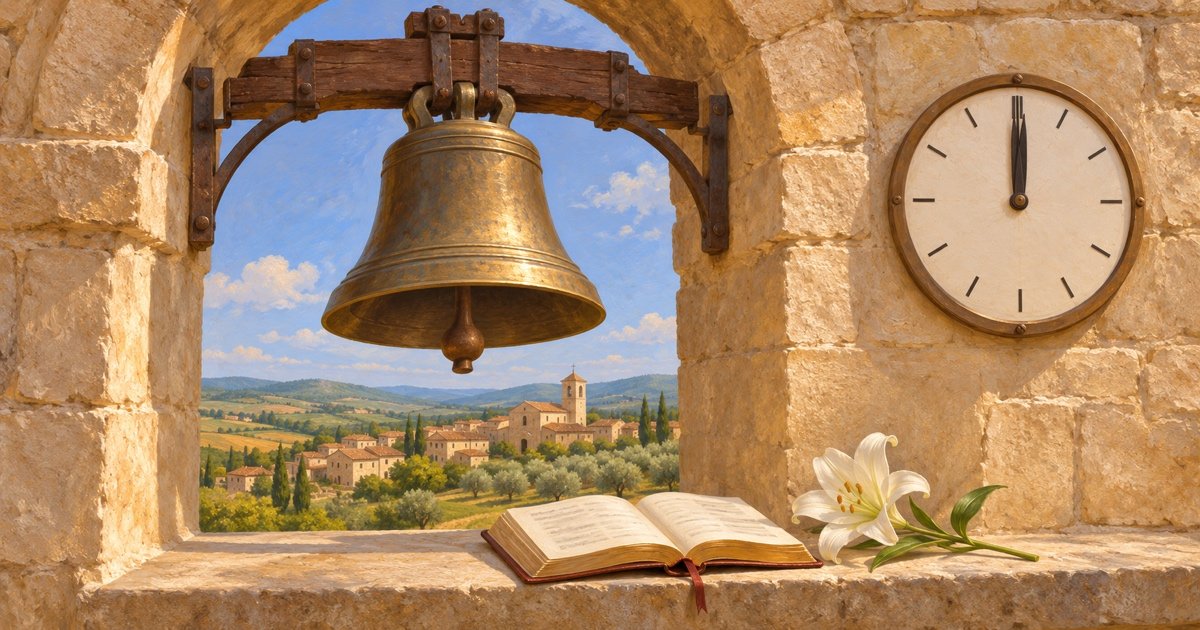
The Angelus is a short Marian prayer that Catholics traditionally pray three times a day: at dawn, at noon and at dusk, usually at 6 am, 12 noon and 6 pm, often at the sound of the church bells. In about two minutes, it recalls the moment the angel Gabriel announced to Mary that she would be the Mother of God's Son, and the moment God became man.
It is one of the simplest prayers in the Catholic tradition: three short exchanges, three Hail Marys, and a closing prayer. Here is what it means, when to pray it, and every word you need.
What is the Angelus?
The Angelus commemorates the Incarnation: the Son of God taking flesh in the womb of the Virgin Mary. It walks through the scene of the Annunciation in three steps. The angel brings the message, Mary says yes, and "the Word was made flesh."
Its name comes from its first word in Latin. The prayer begins Angelus Domini nuntiavit Mariae, "The Angel of the Lord declared unto Mary." Just as the Hail Mary is named after its opening words, the whole prayer took the name of its first one: Angelus, the Angel.
The Church's Directory on Popular Piety and the Liturgy (no. 195) describes it as the traditional way the faithful commemorate the Annunciation, prayed three times daily, and a recollection of the moment the Word became flesh in the womb of the Virgin Mary through the power of the Holy Spirit. Saint Paul VI, writing about it in 1974, said simply that the Angelus does not need to be revised: its simple, biblical form has kept its freshness over the centuries (see Marialis Cultus, 41).
The Angelus is not part of the Liturgy of the Hours, but a devotion that follows the same rhythm of the day.
🔔 Pray the Angelus line by line, with every response written out, in Catho+ →
When to pray the Angelus
Think of the Angelus as three small doors opening in your day:
- At dawn (around 6 am): you begin the day by remembering that God came close to us.
- At noon: you pause in the middle of work, school or errands.
- At dusk (around 6 pm): you close the working day with thanksgiving.
For centuries, church bells rang at these hours to call people to the Angelus. In many towns and villages they still do. Farmers in the fields, shopkeepers, mothers at home would stop for a moment, wherever they were, and pray. The bell did the remembering for them.
If your parish bells do not ring, you can set a reminder on your phone. And if you miss the exact hour, pray it a little later. The point is not the clock: it is to stop, three times a day, and give that moment to God.
The words of the Angelus
The Angelus is built on short exchanges marked V. (the versicle, said by the leader) and R. (the response, said by everyone). After each of the first three exchanges comes a Hail Mary, also split in two. Here is the full text, as it appears in Catho+.
V. The Angel of the Lord declared unto Mary,
R. And she conceived of the Holy Spirit.
V. Hail Mary, full of grace, the Lord is with thee. Blessed art thou among women, and blessed is the fruit of thy womb, Jesus.
R. Holy Mary, Mother of God, pray for us sinners, now and at the hour of our death.
Amen.
V. Behold the handmaid of the Lord,
R. Be it done unto me according to thy word.
V. Hail Mary, full of grace, the Lord is with thee. Blessed art thou among women, and blessed is the fruit of thy womb, Jesus.
R. Holy Mary, Mother of God, pray for us sinners, now and at the hour of our death.
Amen.
V. And the Word was made flesh,
R. And dwelt among us.
V. Hail Mary, full of grace, the Lord is with thee. Blessed art thou among women, and blessed is the fruit of thy womb, Jesus.
R. Holy Mary, Mother of God, pray for us sinners, now and at the hour of our death.
Amen.
V. Pray for us, O holy Mother of God,
R. That we may be made worthy of the promises of Christ.
Let us pray:
Pour forth, we beseech thee, O Lord,
thy grace into our hearts;
that we, to whom the Incarnation of Christ thy Son
was made known by the message of an angel,
may by his Passion and Cross
be brought to the glory of his Resurrection.
Through the same Christ our Lord.
Amen.
Notice how the closing prayer gathers everything together. It starts at the Annunciation ("the message of an angel"), passes through the Cross, and ends at the Resurrection. In a few lines, the whole story of our salvation.
How to pray it, alone or with others
With others
The Angelus is made for praying together. One person leads, everyone else answers:
- The leader says the versicle (V.): "The Angel of the Lord declared unto Mary,"
- Everyone answers with the response (R.): "And she conceived of the Holy Spirit."
- The leader begins the Hail Mary, up to "the fruit of thy womb, Jesus."
- Everyone continues: "Holy Mary, Mother of God…" to the end.
- Repeat for the second and third exchanges.
- After the fourth exchange ("Pray for us, O holy Mother of God"), the leader says "Let us pray" and reads the closing prayer. Everyone answers "Amen."
It works beautifully at home before a meal, in the car, in a classroom or at the start of a meeting. Children quickly learn the responses, and it is a lovely way to let them lead.
Alone
On your own, simply say both parts yourself, the versicle and the response, the first half of each Hail Mary and the second. You can pray it aloud or silently. It takes about two minutes.
A simple way to enter into it: as you say each of the three exchanges, picture the scene. The angel standing before Mary in Nazareth. Mary's quiet "yes." Then the wonder of it: God, who made the stars, now a tiny child within his mother. If you already pray the Hail Mary, you know most of the Angelus by heart. (New to the Hail Mary? It is explained in our guide on how to pray the Rosary.)
In Easter season: the Regina Caeli
During the Easter season, the Angelus gives way to a joyful prayer full of alleluias: the Regina Caeli ("Queen of Heaven"). This custom was set by Pope Benedict XIV in 1742 (see Directory on Popular Piety, 196). The Regina Caeli is prayed at the same times of day, from Easter Sunday to Pentecost Sunday, the fifty days of Easter. In 2027, that is from 28 March to 16 May.
It keeps the same spirit as the Angelus. It still speaks of Mary carrying Jesus in her womb ("he whom you did merit to bear"), but now it rejoices that her Son is risen. Here is the full text, as it appears in Catho+:
Queen of Heaven, rejoice, alleluia.
For he whom you did merit to bear, alleluia.
Has risen, as he said, alleluia.
Pray for us to God, alleluia.
V. Rejoice and be glad, O Virgin Mary, alleluia.
R. For the Lord has truly risen, alleluia.
Let us pray:
O God, who gave joy to the world
through the resurrection of thy Son,
our Lord Jesus Christ,
grant, we beseech thee,
that through his Mother, the Virgin Mary,
we may obtain the joys of everlasting life.
Through the same Christ our Lord.
Amen.
To find out where Easter and Pentecost fall each year, see our guide on the liturgical year. You can also pray the Regina Caeli in Catho+.
The Pope's Sunday Angelus
Every Sunday at noon, the Pope prays the Angelus with the crowds gathered in St. Peter's Square in Rome. As the bells of St. Peter's ring the noon hour, he appears at a window of the Apostolic Palace, high above the square. He speaks briefly to the people, prays the Angelus with them (or the Regina Caeli in Easter season), and gives his blessing.
Pilgrims from every country stand side by side below, and millions follow on radio, television and online. It is a simple, touching sight: the whole Church, at least for a few minutes, praying the same words together. The Church's Directory on Popular Piety (no. 195) notes that the Angelus is deeply rooted in the faith of ordinary Catholics and "strengthened by the example of the Roman Pontiffs."
The Angelus in art: Millet's painting
Many people know the Angelus first through a painting. The Angelus by the French painter Jean-François Millet, painted between 1857 and 1859, hangs today in the Musée d'Orsay in Paris.
It shows two peasants in a potato field at dusk. They have stopped their work, the man has taken off his hat, the woman has joined her hands, and both bow their heads. On the horizon stands a small church tower. We cannot hear the bell, but we know it is ringing. It is the whole spirit of the Angelus in one image: ordinary people, ordinary work, and a moment given to God in the middle of it.
Common questions
Do I have to pray it exactly at 6, 12 and 6?
No. Those are the traditional times, but the Angelus is a devotion, not an obligation. Praying it once a day, at noon for instance, is already a beautiful habit. The Church's Directory on Popular Piety encourages, where the full prayer is difficult, at least the recitation of three Hail Marys.
Is the Angelus only for Catholics?
It is a Catholic prayer, but its heart is the Gospel itself: the Annunciation in Luke's Gospel (Luke 1:26-38) and the opening of John's Gospel, "the Word was made flesh." Any Christian who loves those pages can find something to pray in it.
Is it praying to Mary instead of God?
No. The Angelus is about Jesus: his coming among us, his Cross, his Resurrection. We ask Mary to pray for us, as we would ask a friend, and the closing prayer is addressed to God the Father, through Christ our Lord.
| Pray the Angelus in Catho+ |
Catho+ has the Angelus and the Regina Caeli written out with every versicle and response, so you can pray them anywhere, alone or with others.