Catholic Prayers: The Basic Prayers Every Catholic Knows
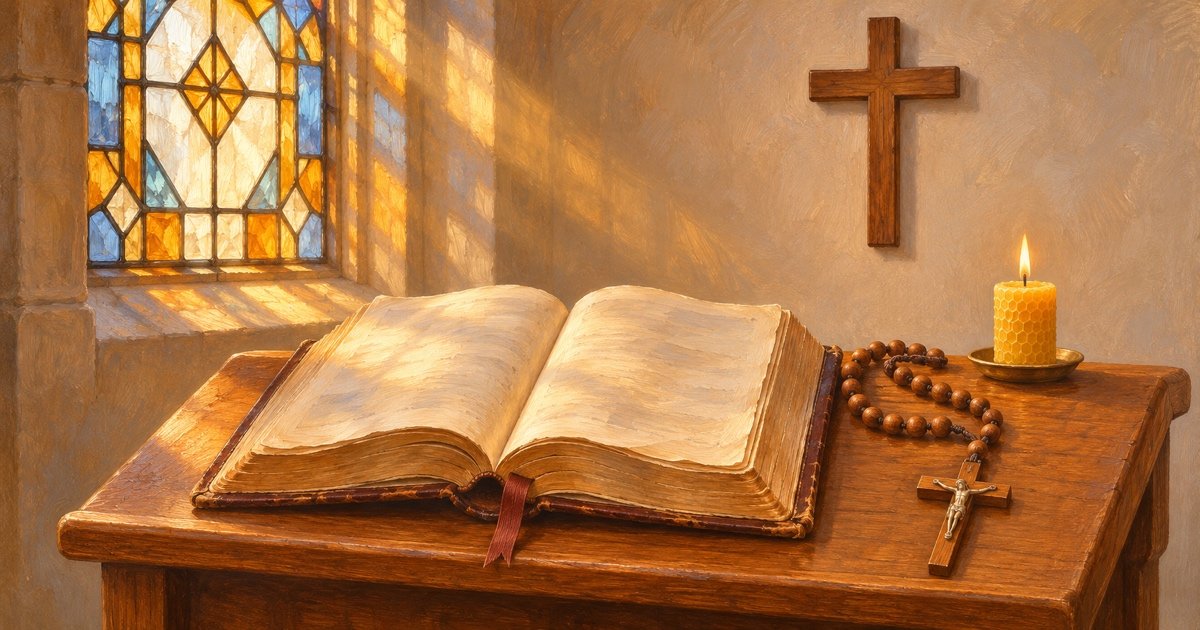
The basic Catholic prayers are the Sign of the Cross, the Our Father, the Hail Mary, the Glory Be and the Apostles' Creed. Around them, most Catholics also learn the Act of Contrition, the Hail Holy Queen, the Memorare, the Guardian Angel Prayer, the St. Michael Prayer and a grace before meals. These few short prayers carry a Catholic through a whole life: they are taught to children, said at Mass and in the Rosary, whispered at hospital bedsides and prayed at funerals.
Below you will find each one written out in full, with a short note on what it means and where it is used. Then, further down, a guide to prayers for every moment: morning and night, times of sorrow, illness, feasts and seasons.
Why learn prayers by heart?
Prayer is first of all a conversation with God, and you can always talk to him in your own words. So why learn set prayers at all?
Because there are days when words do not come. In joy, in fear, in grief or simple tiredness, a prayer you know by heart is there for you, like a path already worn smooth. You do not have to invent anything: you can lean on words that millions of Christians have prayed before you, and that the Church prays with you.
Learned prayers also unite us. A Catholic in Manila, in Lagos, in Warsaw and in Chicago can pray the Our Father together, each in their own language, and know they are saying the same thing. And they teach us how to pray: the more you say them slowly, the more they shape your own conversation with God.
🙏 Every prayer on this page, and many more, is written out in full in Catho+ →
The essential Catholic prayers
Here are the prayers every Catholic knows, in the traditional English wording used in Catho+. If you are just starting out, learn the first five: they are the backbone of the Rosary and of daily prayer.
1. The Sign of the Cross
The shortest prayer of all, and the one that opens and closes almost every other. With your right hand, touch your forehead ("Father"), your chest ("Son"), your left shoulder and then your right ("and of the Holy Spirit"). In a single gesture, you profess faith in the Holy Trinity and mark yourself with the Cross of Christ. The Catechism says simply: "The Christian begins his day, his prayers, and his activities with the Sign of the Cross" (CCC 2157).
In the name of the Father,
and of the Son,
and of the Holy Spirit.
Amen.
Pray the Sign of the Cross in Catho+
2. The Our Father
The prayer Jesus himself taught his disciples when they asked him how to pray (Matthew 6:9-13; Luke 11:1-4). It is prayed at every Mass, in the Rosary and in the Liturgy of the Hours. The Catechism, following the early Christian writer Tertullian, says that the Lord's Prayer "is truly the summary of the whole gospel" (CCC 2761): in a few lines it praises God, asks for his kingdom, our daily bread, forgiveness and protection from evil.
Our Father, who art in heaven,
hallowed be thy name;
thy kingdom come,
thy will be done
on earth as it is in heaven.
Give us this day our daily bread,
and forgive us our trespasses,
as we forgive those who trespass against us;
and lead us not into temptation,
but deliver us from evil.
Amen.
3. The Hail Mary
The best-loved prayer to the Mother of God. Its first half is made of words from the Gospel of Luke: the angel Gabriel's greeting to Mary (Luke 1:28) and the words of her cousin Elizabeth (Luke 1:42). In the second half, the Church asks Mary to pray for us, now and at the hour of our death. It is the prayer repeated on the beads of the Rosary.
Hail Mary, full of grace,
the Lord is with thee.
Blessed art thou among women,
and blessed is the fruit of thy womb, Jesus.
Holy Mary, Mother of God,
pray for us sinners,
now and at the hour of our death.
Amen.
4. The Glory Be
A short hymn of praise to the Holy Trinity, the kind of prayer called a "doxology" (from the Greek for "word of glory"). It closes each decade of the Rosary and each psalm in the Liturgy of the Hours. It asks for nothing: it simply gives glory to God, who always was and always will be.
Glory be to the Father,
and to the Son,
and to the Holy Spirit,
as it was in the beginning,
is now, and ever shall be,
world without end.
Amen.
5. The Apostles' Creed
A creed is a summary of what Christians believe (the word comes from the Latin credo, "I believe"). The Catechism explains that the Apostles' Creed "is so called because it is rightly considered to be a faithful summary of the apostles' faith," and that "It is the ancient baptismal symbol of the Church of Rome" (CCC 194). It opens the Rosary. At Sunday Mass, Catholics usually profess the longer Nicene Creed instead.
I believe in God, the Father almighty,
Creator of heaven and earth,
and in Jesus Christ, his only Son, our Lord,
who was conceived by the Holy Spirit,
born of the Virgin Mary,
suffered under Pontius Pilate,
was crucified, died and was buried;
he descended into hell;
on the third day he rose again from the dead;
he ascended into heaven,
and is seated at the right hand of God the Father almighty;
from there he will come to judge the living and the dead.
I believe in the Holy Spirit,
the holy catholic Church,
the communion of saints,
the forgiveness of sins,
the resurrection of the body,
and life everlasting.
Amen.
Pray the Apostles' Creed in Catho+
6. The Act of Contrition
A prayer of sorrow for sin, said in confession after the priest gives you your penance, and at the end of the day when you look back on it. The Catechism defines contrition as "sorrow of the soul and detestation for the sin committed, together with the resolution not to sin again" (CCC 1451), and that is exactly what this prayer says. Other versions exist, with slightly different words; this is the traditional one.
O my God, I am heartily sorry
for having offended thee,
and I detest all my sins
because of thy just punishments,
but most of all because they offend thee, my God,
who art all good and deserving of all my love.
I firmly resolve, with the help of thy grace,
to sin no more and to avoid the near occasions of sin.
Amen.
Pray the Act of Contrition in Catho+. Going to confession soon? Our guide on how to go to confession walks you through it, step by step.
7. The Hail Holy Queen
Known in Latin as the Salve Regina, this is the prayer that traditionally closes the Rosary. It is the cry of "poor banished children of Eve" turning to Mary as a mother, asking her to show us Jesus at the end of our earthly exile. It is tender, honest about sorrow, and full of hope.
Hail, holy Queen, Mother of mercy,
our life, our sweetness and our hope.
To thee do we cry, poor banished children of Eve.
To thee do we send up our sighs,
mourning and weeping in this valley of tears.
Turn then, most gracious advocate,
thine eyes of mercy toward us,
and after this our exile,
show unto us the blessed fruit of thy womb, Jesus.
O clement, O loving, O sweet Virgin Mary.
V. Pray for us, O holy Mother of God.
R. That we may be made worthy of the promises of Christ.
Amen.
Pray the Hail Holy Queen in Catho+
8. The Memorare
Its name is its first word in Latin: Memorare, "Remember." It is a prayer of complete trust, for the moments when you need help and do not know where else to turn. You remind Mary, with a child's confidence, that no one who came to her was ever left alone.
Remember, O most gracious Virgin Mary,
that never was it known
that anyone who fled to thy protection,
implored thy help,
or sought thy intercession was left unaided.
Inspired by this confidence,
I fly unto thee, O Virgin of virgins, my Mother.
To thee do I come, before thee I stand,
sinful and sorrowful.
O Mother of the Word Incarnate,
despise not my petitions,
but in thy mercy hear and answer me.
Amen.
9. The Guardian Angel Prayer
Often the very first prayer a child learns, and one many adults never stop saying. The Church teaches that each of us is cared for by an angel: "Beside each believer stands an angel as protector and shepherd leading him to life," says the Catechism, quoting Saint Basil (CCC 336). The Church celebrates the Holy Guardian Angels on 2 October.
Angel of God, my guardian dear,
to whom God's love commits me here,
ever this day be at my side,
to light and guard, to rule and guide.
Amen.
Pray the Guardian Angel Prayer in Catho+
10. The St. Michael Prayer
A prayer for protection against evil, addressed to Saint Michael the Archangel. Pope Leo XIII introduced it for the whole Church at the end of the nineteenth century, and for decades it was said at the end of Mass. In 1994, Saint John Paul II noted that it was no longer recited after Mass, but asked everyone not to forget it and to pray it for help in the spiritual battle (Regina Caeli address, 24 April 1994).
Saint Michael the Archangel,
defend us in battle.
Be our protection against the wickedness and snares of the devil.
May God rebuke him, we humbly pray,
and do thou, O Prince of the heavenly hosts,
by the power of God,
cast into hell Satan,
and all the evil spirits,
who prowl about the world
seeking the ruin of souls.
Amen.
Pray the St. Michael Prayer in Catho+
11. Grace Before Meals
The family prayer at the table. Begin with the Sign of the Cross, say these few words together, and the meal becomes a moment of thanksgiving. It is one of the easiest ways to bring prayer into a home with children.
Bless us, O Lord,
and these thy gifts,
which we are about to receive
from thy bounty,
through Christ our Lord.
Amen.
There is also a less familiar Grace After Meals, which ends with a prayer for the dead:
We give thee thanks, almighty God,
for all thy benefits,
who livest and reignest,
world without end.
Amen.
May the souls of the faithful departed,
through the mercy of God,
rest in peace.
Amen.
Grace Before Meals and Grace After Meals in Catho+
12. Prayer to the Holy Spirit
A short prayer to ask for the light and strength of the Holy Spirit: before a decision, an exam, a hard conversation, or simply before you pray. It is also a beautiful prayer to open a meeting or a class.
Come, Holy Spirit, fill the hearts of thy faithful
and kindle in them the fire of thy love.
V. Send forth thy Spirit and they shall be created.
R. And thou shalt renew the face of the earth.
Let us pray:
O God, who didst instruct the hearts of the faithful
by the light of the Holy Spirit,
grant us in the same Spirit to be truly wise,
and ever to rejoice in his consolation.
Through Christ our Lord.
Amen.
Pray the Prayer to the Holy Spirit in Catho+
Prayers for every moment of the day
Once you know the basics, the Church offers prayers for every hour.
- In the morning: offer your whole day to God before it begins. Our guide to Catholic morning prayer explains the Morning Offering and a simple routine.
- At noon: pause for the Angelus, two minutes to remember the moment God became man.
- At 3 pm: many Catholics pray the Divine Mercy Chaplet at the hour of Christ's death.
- At night: look back on the day, thank God, ask his forgiveness and entrust yourself to him. See our guide to Catholic night prayer.
Prayers by need
- To pray with Mary: the Rosary, step by step, and the mysteries of the Rosary for each day.
- For someone who is sick: prayers for the sick and for healing, and how to ask for the Anointing of the Sick, in our guide to prayers for the sick.
- For a special intention: nine days of prayer, as the apostles prayed before Pentecost. See how to pray a novena.
- In times of trouble: the Memorare above, or the Prayer in Times of Need in Catho+.
- For those who have died: the Prayer for the Deceased and the prayer for the Holy Souls in Catho+.
- For your family: the Prayer for Families in Catho+.
- To ask a saint's help: find the right saint for your work, your illness or your country in our guide to patron saints.
- To make peace with God: the Act of Contrition above, and the sacrament itself, in how to go to confession.
Prayers through the year
The Church's year has its own prayers too. In Lent, many parishes pray the Stations of the Cross on Fridays. In the Easter season, the Angelus gives way to the joyful Regina Caeli. In Advent, which starts four Sundays before Christmas, Catho+ has an Advent prayer, and in the Philippines the faithful gather before dawn for Simbang Gabi. To see where you are in the year, read our guide to the liturgical year.
How to start a daily habit of prayer
You do not need to pray every prayer on this page every day. Start small, and be faithful:
- Pick a time and a place. When you wake up, before you leave home, at the table, before bed. A habit grows best where it has a fixed spot in the day.
- Start with a few minutes. A Sign of the Cross, an Our Father, a Hail Mary and a Glory Be take less than two minutes. That is already prayer.
- Pray slowly. It is better to say one Our Father thinking of each line than ten in a hurry.
- Add your own words. After the set prayers, tell God simply what is on your heart: thanks, worries, the people you love.
- Pray with others. With your children, your spouse, a friend. Praying together helps everyone keep going.
Teaching children? Begin with the Sign of the Cross, the Guardian Angel Prayer and grace before meals, then the Our Father and Hail Mary. Little ones learn by hearing the same words every day, long before they understand them all.
Common questions
What are the five basic Catholic prayers?
Most catechisms and parishes start with the Sign of the Cross, the Our Father, the Hail Mary, the Glory Be and the Apostles' Creed. Together they make up most of the Rosary, so once you know them, you can pray it.
Why do the prayers say "thee" and "thy"?
These are the traditional English wordings, which many Catholics learned as children and still pray today. You will also find modern versions that say "you" and "your." Both are fine: God listens to the heart, not to the grammar. Catho+ uses the traditional words most English-speaking Catholics know by heart.
Do I have to say the words exactly?
For private prayer, no. If you forget a line or use a slightly different version, your prayer is just as real. When praying together, at Mass or in a group, it helps to use the same words so everyone can pray as one.
Why do Catholics pray to Mary and the saints?
Catholics do not worship Mary or the saints: worship belongs to God alone. We ask them to pray for us, as you would ask a friend to pray for you. Notice that the Hail Mary, the Memorare and the Hail Holy Queen all ask Mary to lead us to Jesus.
Can I pray these prayers if I am not Catholic?
Of course. The Our Father, the Glory Be and the Apostles' Creed are shared by many Christians, and anyone who wants to pray is welcome to these words. If you feel drawn to the Catholic faith, our guide on how to become Catholic explains the first steps.
| Open the prayers in Catho+ |
Catho+ has all these prayers and many more, from litanies and novenas to the Rosary and the Divine Mercy Chaplet, written out in full so you can pray them anywhere, alone or with your family.