How to Go to Confession: What to Say, Step by Step
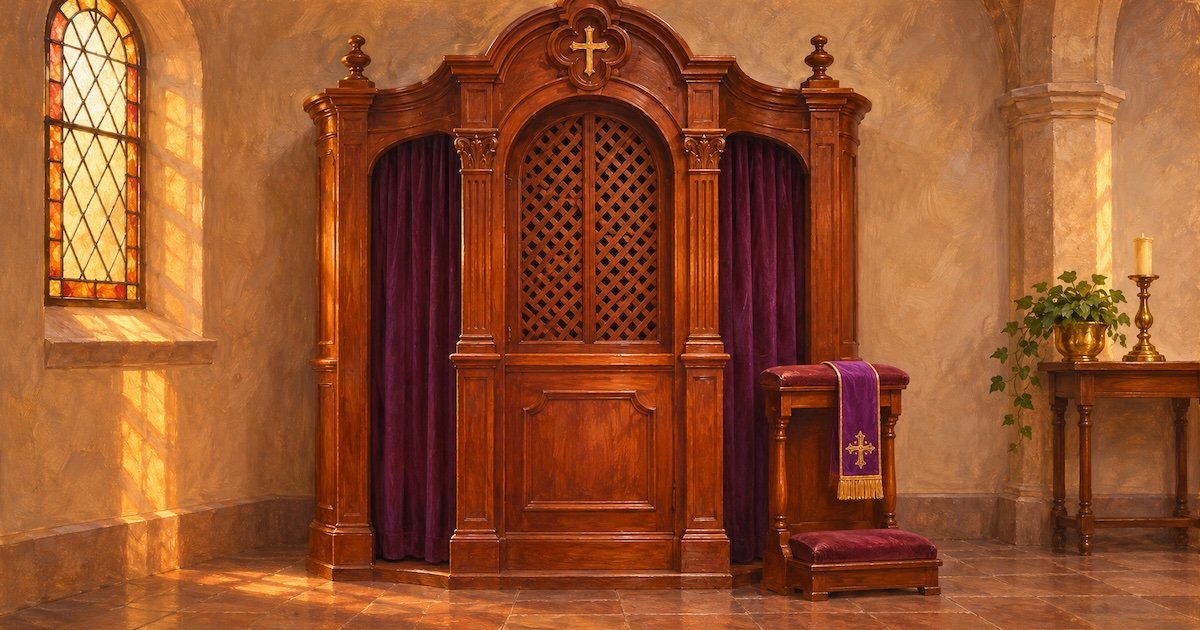
Going to confession is simpler than most people fear. You prepare by looking honestly at your life, you tell your sins to a priest, you say that you are sorry, and he gives you a small penance and God's forgiveness in the words of absolution. The whole thing often takes five minutes. And if you have forgotten the words, or have not been in years, the priest will gladly guide you.
This guide walks you through it step by step: how to prepare, what to say, the Act of Contrition, and what happens after.
What is confession?
Confession is one of the seven sacraments. The Church calls it by several names, and each one shows a side of it: the sacrament of Penance, of Conversion, of Confession, of Forgiveness and of Reconciliation (see Catechism, 1423-1424).
Think of the parable of the prodigal son. The son rehearses his little speech on the road home, but the father sees him from far off, runs to him and throws his arms around him before he has finished. Confession is that embrace. Sin hurts our friendship with God and with the Church; this sacrament heals both (see Catechism, 1440 and 1468-1469).
Why tell a priest, and not only God in private? Because Jesus gave his apostles the power to forgive sins in his name, and because we are body and soul: we need to say our sins out loud and to hear that we are forgiven. Even from a simply human point of view, putting our faults into words sets us free (see Catechism, 1455-1456). The priest is not there to judge you; he stands in for Christ, who forgives.
🙏 Learn the Act of Contrition before you go, in Catho+ →
Before you go: an examination of conscience
The Church asks us to prepare for confession with an examination of conscience: a quiet, honest look at our life in the light of God's Word (see Catechism, 1454). The question is simply: where have I failed to love God and my neighbor?
Take ten minutes in a quiet place, ask the Holy Spirit for light, and go through some questions. Here is a short set, based on the Ten Commandments. It is a simple help to get you started, not an official text; your parish or a prayer book may offer a fuller one.
- God first. Have I put anything (money, work, success, a relationship, my phone) before God? Have I neglected prayer? Have I dabbled in superstition or the occult?
- God's name. Have I used God's name carelessly or in anger? Have I mocked holy things?
- The Lord's Day. Have I missed Sunday Mass through my own fault? Have I kept Sunday as a day for God and for rest?
- Family. Have I respected and helped my parents? Have I been patient and present with my spouse and children?
- Life. Have I hurt anyone by violence, cruel words or a grudge I refuse to let go? Have I harmed my own health, through drink or drugs for example?
- Purity. Have I been faithful in my thoughts, looks and actions? Have I used others as objects?
- Honesty. Have I stolen, cheated, or failed to do the work I am paid for? Have I been generous to people in need?
- Truth. Have I lied, gossiped, or damaged someone's reputation?
- Desires. Have I let impure desires take root in my heart?
- Envy. Have I been jealous of what others have, instead of grateful for what I have?
You must confess every grave (mortal) sin you remember after an honest examination, saying what kind of sin it was and, as best you can, how many times (Code of Canon Law, canon 988 §1). Confessing your everyday faults, the venial sins, is not strictly required but is warmly recommended (canon 988 §2; Catechism, 1458). Not sure which is which? Our guide to mortal and venial sin explains the difference, and you can always ask the priest.
What to say in confession, step by step
The exact words vary from one country and one priest to another, and the priest will guide you. But a confession usually goes like this:
- The greeting. The priest welcomes you. You both make the Sign of the Cross: "In the name of the Father, and of the Son, and of the Holy Spirit. Amen." He may read a short passage from Scripture or invite you to trust in God's mercy (see Catechism, 1480).
- Start your confession. The usual words in English are: "Bless me, Father, for I have sinned. It has been [three months, two years, a long time...] since my last confession." If you do not remember, say so: "It has been many years, I'm not sure how many." You can also simply say, "Father, I'm not sure what to say, can you help me?"
- Tell your sins. Simply and briefly: what you did, and roughly how often. No need for long stories or excuses. When you have finished, you can say: "For these and all the sins of my past life, I am sorry."
- Listen to the priest. He may give you a word of advice or encouragement, then he gives you a penance: a prayer to say or a good action to do.
- Say an act of contrition. The priest invites you to express your sorrow. You can pray the Act of Contrition (below), or say in your own words that you are sorry and want to change.
- Receive absolution. The priest extends his hand and says the prayer of absolution, which ends with: "I absolve you from your sins in the name of the Father, and of the Son and of the Holy Spirit" (Catechism, 1449). You answer: "Amen."
- Go in peace. The priest may say a short word of thanksgiving and dismiss you. You can answer "Thank you, Father," and you are free.
The Act of Contrition
Sorrow for sin, called contrition, is the most important thing you bring to confession: more important than perfect words (see Catechism, 1451). The Act of Contrition puts that sorrow into a prayer. Here is the version in Catho+:
O my God, I am heartily sorry
for having offended thee,
and I detest all my sins
because of thy just punishments,
but most of all because they offend thee, my God,
who art all good and deserving of all my love.
I firmly resolve, with the help of thy grace,
to sin no more and to avoid the near occasions of sin.
Amen.
Several versions exist, and your parish may use another one. Any of them is fine, and so are your own sincere words. If you cannot remember it, bring it with you on a piece of paper or open the Act of Contrition in Catho+.
Going back after many years
If it has been ten, twenty or forty years, do not be afraid. This is exactly what confession is for. The father in the parable did not ask his son where he had been; he ran to meet him.
- Tell the priest at the start that it has been a long time. He will help you through it, question by question if needed.
- You do not need a perfect list. Confess the grave sins you remember after an honest examination. If a grave sin you forgot comes back to you later, simply mention it at your next confession.
- What you say stays there. The priest is bound by the seal of confession, which is inviolable: he may never betray a penitent in any way, for any reason (canon 983 §1). He may not even use what he heard in any way that could harm you (canon 984). The Catechism says this secret admits no exceptions (see Catechism, 1467).
- You can choose your priest. Any approved priest can hear your confession, even in another parish or a different rite of the Church (canon 991).
- Make an appointment if you like. If you expect it to take a while, call the parish and ask for a time with a priest, rather than worrying about the queue behind you.
Face to face or behind a screen?
You choose. Church law requires churches to have confessionals with a fixed screen between the penitent and the priest, freely available to anyone who wants them (canon 964 §2). So you can always stay anonymous if you prefer. Many churches also offer a chair facing the priest, for those who would rather talk face to face. Pick whichever helps you speak freely.
How often should you go?
The minimum the Church asks: once you have reached the age of reason, you must confess your grave sins at least once a year (canon 989; Catechism, 1457). Anyone aware of a grave sin should go to confession before receiving Holy Communion (see Catechism, 1457).
But the minimum is not the ideal. Many Catholics go once a month, or every few weeks, even when they have only everyday faults to confess. Regular confession helps us form our conscience, fight our bad habits and grow (see Catechism, 1458).
When and where to find confession
- Regular times. Most parishes offer confession at set times each week, often on Saturdays. You will usually find them on the parish website or in the Sunday bulletin.
- Advent and Lent. These are the seasons when many parishes hold penance services: a shared celebration with readings, a homily and an examination of conscience, followed by individual confession with several priests (see Catechism, 1482). They are a good moment to come back. See our guide to when Advent starts.
- Not sure where to go? The church finder in Catho+ shows the churches near you; then check that parish's website or call for its confession times.
After confession: penance and peace
Do your penance as soon as you can, before you forget, often right there in the church. It is usually small: a few prayers, a reading, an act of kindness. It is not a "price" for forgiveness, which is free; it is a first step to heal the harm sin has done, chosen by the priest to fit your situation (canon 981; Catechism, 1460). If you have wronged someone, for example by stealing or damaging their reputation, do what you can to set it right (see Catechism, 1459).
Then take a moment to say thank you. The sins you confessed are forgiven, completely. The Catechism speaks of peace and serenity of conscience, a true "spiritual resurrection" (see Catechism, 1468).
| Pray the Act of Contrition in Catho+ |
Catho+ has the Act of Contrition ready on your phone for the moment you need it, and shows the churches near you so you can find a place to go.