Simbang Gabi: The Nine Christmas Masses of the Philippines
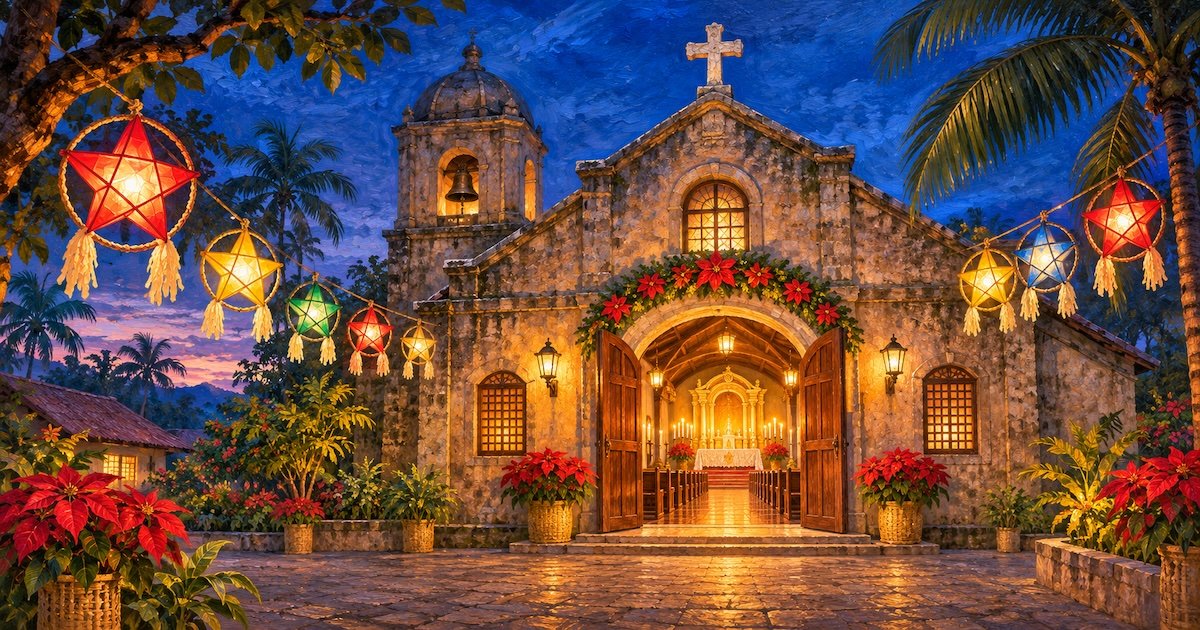
Simbang Gabi is a novena of nine Masses that Filipino Catholics attend to prepare for Christmas, one each day from 16 to 24 December, traditionally before dawn. The name is Tagalog for "night Mass". It is also known by two Spanish names: Misa de Gallo, the "Rooster's Mass", and Misa de Aguinaldo, the "Mass of the Gift". Today, many parishes also offer evening Masses, and Filipino communities keep the custom all over the world.
Below: what Simbang Gabi is, where it comes from, how it is kept in the Philippines and abroad, what to make of the famous "nine Masses, one wish" belief, and how to live the nine days well.
What is Simbang Gabi?
Simbang Gabi is a Christmas novena: nine days of prayer that lead up to a great feast. But instead of praying at home, people go to Mass, every day, nine days in a row. (New to novenas? Our guide How to pray a novena explains where the nine days come from.)
When Pope Francis celebrated Simbang Gabi in Saint Peter's Basilica in 2019, he described it simply: for centuries, the Philippines has had a novena of preparation for Christmas, called Simbang Gabi, "Night Mass".
Three things give it its character:
- The hour. In the Philippines, the traditional Masses are celebrated very early, often around 4 or 5 in the morning, while it is still dark.
- Mary. Simbang Gabi is lived as a novena in honor of the Blessed Virgin Mary. With her, the Church waits for the birth of her Son.
- The community. Whole families go together, and the church is often full before the bells have finished ringing. After Mass, people linger outside over hot drinks and rice cakes.
Simbang Gabi, Misa de Gallo, Misa de Aguinaldo: what is the difference?
The three names are often used for the same nine Masses, but they come from different places:
- Simbang Gabi ("night Mass") is the Tagalog name, the one most Filipinos use today.
- Misa de Gallo ("Rooster's Mass") is Spanish, from the hour when the roosters crow. In the Philippines it can mean the whole series, but today it is often used for the last Mass only, on 24 December. Elsewhere, the name is also used for the Midnight Mass of Christmas.
- Misa de Aguinaldo ("Mass of the Gift") comes from aguinaldo, the Spanish word for a Christmas gift. It is the name the custom also carries in Mexico and other Spanish-speaking countries.
Where does Simbang Gabi come from?
There is no single, certain history of Simbang Gabi, and the stories told about it do not all agree. Here is what the sources share.
From Mexico to the Philippines
The custom came to the Philippines from Mexico, through the missionaries of the Spanish period. In Mexico, according to tradition, it goes back to 1587, when the Pope allowed Fray Diego de Soria, prior of the Augustinian convent of San Agustín Acolman, to celebrate the Christmas Masses outdoors, because the church could not hold the crowds. The custom reached the Philippines with missionaries coming from Mexico in the seventeenth century; 1669 is the date often given.
The same Mexican Masses also gave rise to another nine-day custom: Las Posadas, kept in Mexico and much of Latin America on the same nights, from 16 to 24 December. The two are cousins rather than twins. Simbang Gabi is the Mass itself, in church; Las Posadas are a procession from house to house, recalling Mary and Joseph's search for a place to stay in Bethlehem.
Why before dawn?
The most common explanation is a practical one. Most people worked in the fields or at sea. Farmers began before sunrise, to escape the heat of the day, and by evening they were too tired for the evening novena prayers that were customary in the Spanish world. So the priests moved the Mass to the early morning, before work. The farmers and fishermen, woken by the roosters, heard the Gospel and asked God for a good harvest and a good catch before heading out.
Over time, the hour itself became part of the meaning. The Church prepares for Christmas in the dark of winter (in the northern hemisphere) and speaks of Christ as the light that comes into the darkness. Getting up while it is still night and walking to church to welcome that light is Advent made visible. In Zechariah's song, which the Church prays every morning, Christ is the dawn that visits us from on high (Luke 1:78–79).
Kept and confirmed by the Church
Simbang Gabi is a popular devotion, but it has always been closely tied to the Church's liturgy, since it is the Mass itself. In 1953, the Philippine bishops, gathered at the First Plenary Council of the Philippines, formally asked Rome to let the practice of the Misa de Gallo continue, and Rome gave its permission.
Later, as cities grew and people's working hours changed, parishes in Manila began to offer the novena in the evening too, so that more people could take part. That is how the name "Simbang Gabi", night Mass, came to be used for both the dawn and the evening Masses.
🌟 Pray the O Antiphons in the last days before Christmas with Catho+ →
How Simbang Gabi is celebrated in the Philippines
The dawn Masses
Traditionally, the church bells ring in the dark to call people to Mass. In some rural towns, a brass band goes around playing Christmas music an hour before Mass, and in the past, parish priests were known to go from door to door to wake the faithful. Mass usually begins around 4 or 5 in the morning, sometimes earlier. In big churches, the crowds spill out onto the street and the square.
Today, many parishes also hold evening Masses, often late at night. Times vary a lot from one parish to another, so check your own parish's schedule. You can find a church and Mass times near you in Catho+.
The parol
From December, Filipino homes, streets and churches are lit with the parol, a star-shaped lantern. The word comes from the Spanish farol, "lantern". The star recalls the Star of Bethlehem that led the Wise Men to the child Jesus. According to a popular account, lanterns were once carried to light the way to church for Simbang Gabi. The province of Pampanga is especially known for its lantern-making.
You will also see the belén, the Nativity scene, in churches, squares and homes during the nine days.
Bibingka and puto bumbong
After the dawn Mass, it is a cherished tradition to share a simple breakfast outside the church. The two classics are:
- Bibingka: a rice cake cooked with heat from above and below, so that it is charred on top and underneath.
- Puto bumbong: a purple rice cake steamed in bamboo tubes, brushed with butter and topped with grated coconut and sugar.
They are usually eaten with salabat, a hot ginger drink, or thick hot chocolate, tsokolate. Today, many people buy them from the stalls near the church and take them home.
Simbang Gabi around the world
Wherever Filipinos have settled, Simbang Gabi has gone with them. In the United States, Canada, Italy and elsewhere, Filipino communities gather in their parishes for the nine days, and many non-Filipino Catholics now join them.
- Usually in the evening. Outside the Philippines, most Simbang Gabi Masses are celebrated in the evening, often from 16 to 24 December, or from 15 to 23 December so that 24 December is left for Christmas Eve. Some parishes keep the early-morning hour.
- A real parish custom. In 2024, for example, the Archdiocese of Chicago listed 55 parishes holding Simbang Gabi Masses.
- Familiar touches. Churches are decorated with parols, Filipino carols are sung, sometimes in Tagalog, and the Mass is often followed by a meal in the parish hall.
- In Rome. Simbang Gabi had been celebrated in the Diocese of Rome for years when, on 15 December 2019, Pope Francis celebrated it with the Filipino community in Saint Peter's Basilica, the first time a pope had done so. He thanked Filipinos abroad for sharing their faith and encouraged them to keep being "smugglers of the faith".
If you are a Filipino far from home, Simbang Gabi can be a beautiful way to rediscover the faith you grew up with. Look for a parish near you with a Filipino community, or simply go to Mass on those nine days wherever you are.
Complete all nine, and your wish comes true?
You may have heard it: if you attend all nine Masses, your wish will be granted. It is a well-known popular belief, but it is not Church teaching, and it can quietly turn a prayer into a deal: "I give you nine Masses, you give me what I ask."
There is something true underneath it. Bringing a heartfelt intention to God for nine days, with faith and perseverance, is exactly what a novena is, and Jesus himself invites us to ask, to seek and to knock. But God is not a vending machine, and his love does not depend on a perfect attendance record. As one archdiocese put it in its explanation of the custom, the blessing does not depend on the number of Masses attended: what matters is what is in the heart.
So go with your intentions, and go with confidence. And if you miss a day because you are sick, working or caring for someone, do not be discouraged: simply keep going.
How to live Simbang Gabi well
- Bring one intention. Choose a person or a need to carry through the nine days, and offer each Mass for it.
- Listen to the readings. From 17 December, the Gospels at Mass tell the events that led to Jesus' birth: the announcements to Zechariah, to Mary and to Joseph, and the Visitation. Nine days of Mass are nine days with those stories.
- Pray with Mary. Simbang Gabi is a Marian novena. Pray a decade of the Rosary on the way to church, or the Novena to Our Lady in Catho+. The Church's Directory on Popular Piety and the Liturgy calls Advent a time "particularly apt for the cult of the Mother of God" (Directory, 101).
- Pray the O Antiphons. From 17 to 23 December, the Church calls on Christ with his great biblical names: Wisdom, Root of Jesse, Key of David, Rising Sun, Emmanuel (Directory, 103).
- Stop at the Nativity scene. After Mass, take a moment before the belén, with the Prayer Before the Nativity Scene.
- Go to confession. Many parishes offer extra confessions before Christmas. It is the best way to prepare a place for Jesus.
Common questions
When is Simbang Gabi?
Every year from 16 to 24 December, the nine days before Christmas. The dates do not change, whatever the day of the week. Parishes with evening Masses often begin on the evening of 15 December and end on 23 December.
Does Simbang Gabi replace Christmas Mass?
No. The nine Masses prepare for Christmas; they do not replace it. Christmas Day, 25 December, is a holy day of obligation, and Catholics still go to a Christmas Mass, at the vigil on the evening of 24 December, at midnight, or on Christmas Day.
Do I have to be Filipino to go?
Not at all. Simbang Gabi is a Mass, and everyone is welcome. Many parishes outside the Philippines celebrate it for the whole parish, and Filipino communities are glad to share it.
Is Simbang Gabi the same as Las Posadas?
No, but they are cousins. Both are Christmas novenas from 16 to 24 December, both came out of the Spanish missions, and both have Mexican roots. Simbang Gabi is a series of Masses in church. Las Posadas, kept in Mexico and much of Latin America, is a procession through the neighborhood recalling Mary and Joseph's search for shelter in Bethlehem.
What if I cannot go to all nine?
Go to as many as you can. Simbang Gabi is a gift to receive, not a test to pass. You can also keep the nine days at home, with a short prayer each evening before the Nativity scene or with the O Antiphons.
What does Simbang Gabi have to do with Advent?
It is Advent at its most intense. The last days before Christmas are the final stretch of the season, when the waiting grows stronger. See our guides When does Advent start? and, for the other great Marian feasts of December, the Immaculate Conception (8 December, the principal patronal feast of the Philippines) and Our Lady of Guadalupe (12 December).
| Find a church and Mass times in Catho+ |
Catho+ helps you find a church and Mass times near you, wherever you are in the world, and gathers the prayers of Advent and Christmas, from the O Antiphons to the Prayer Before the Nativity Scene, so you can live the nine days of Simbang Gabi to the full.