Las Posadas: The Nine Nights Before Christmas, Explained
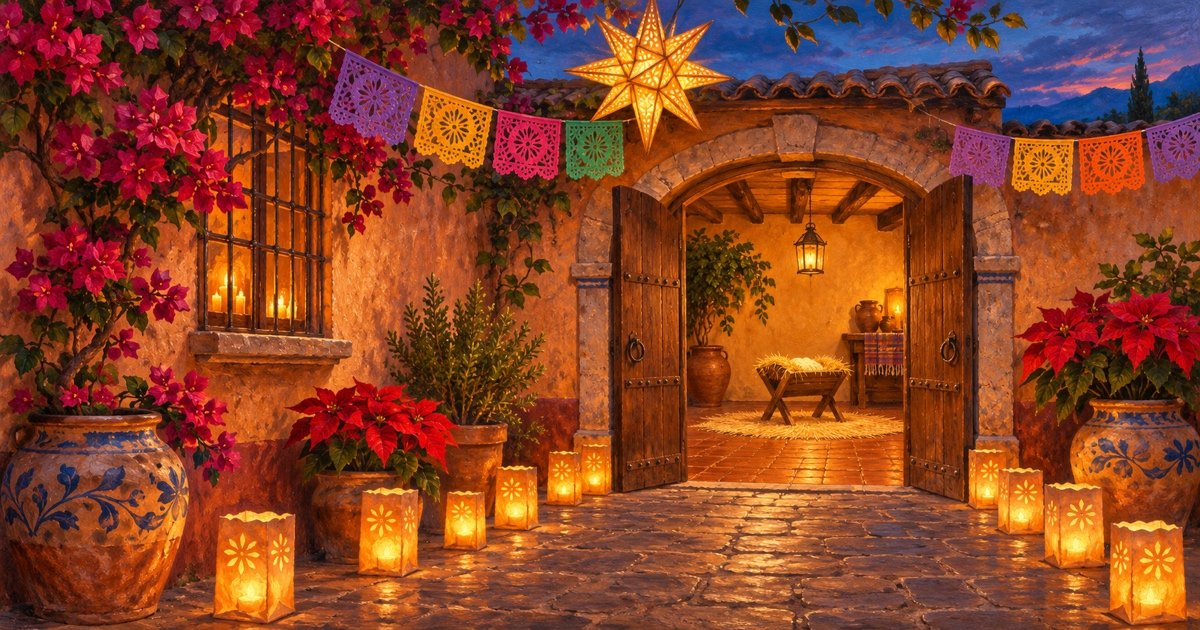
Las Posadas is a Christmas novena from Mexico and Latin America: for nine evenings, from 16 to 24 December, neighbors walk in procession with Mary and Joseph, knock on doors to ask for shelter, and are finally welcomed in to pray and celebrate. The word posada means "inn" or "lodging". The custom recalls the night Mary and Joseph arrived in Bethlehem and found, as Saint Luke says, "no room for them in the inn".
Below: what the posadas recall, where they come from, how an evening unfolds, the piñata, the food, and how you can keep the custom yourself, wherever you live.
What the posadas recall
The Gospel tells the story in a few lines. Caesar Augustus ordered a census, so Joseph went up from Nazareth to Bethlehem, the town of David, "to be enrolled with Mary, his betrothed, who was with child". While they were there, Mary gave birth to her son, "and laid him in a manger, because there was no room for them in the inn" (Luke 2:5-7).
The posadas turn those lines into a walk. Each evening, the community becomes the Holy Family on the road, and also the people of Bethlehem behind their doors. Some say no. One, at last, says yes.
The Church knows this custom well. The Vatican's Directory on Popular Piety and the Liturgy (2001), in its pages on Advent, speaks of processions that represent the journey of Joseph and Mary to Bethlehem and their search for a place where Jesus would be born, and names them: "the posadas in the Hispanic and Latin American tradition" (Directory, 99). In the same section, it notes how sensitive the faithful are, in Advent, to the hardships Mary faced while she was expecting her child (Directory, 97).
Why nine nights?
Nine days of prayer before a feast is a novena, one of the oldest forms of Catholic devotion. The posadas are the great popular form of the Christmas novena in Mexico. Many people also see in the nine nights the nine months that Mary carried Jesus. If you are new to novenas, our guide How to pray a novena explains the idea, and its section on the Christmas novena places the posadas alongside the other customs of these last days before Christmas.
Where Las Posadas come from
The posadas were born in sixteenth-century Mexico, a few decades after the Spanish conquest, when Franciscan, Dominican and Augustinian friars were preaching the Gospel to the Indigenous peoples.
The origin is attributed to the Augustinian convent of San Agustín de Acolman, northeast of Mexico City, near the pyramids of Teotihuacán. According to Mexico's National Institute of Anthropology and History (INAH), which runs the convent today as a museum, its prior, Friar Diego de Soria, obtained from Pope Sixtus V in 1587 a bull authorizing the misas de aguinaldo, "Christmas gift Masses", celebrated from 16 to 24 December. (Some accounts give the year as 1586.)
Those first posadas were Masses in church, nine of them, one for each day before Christmas. Father José de Jesús Aguilar, of the Archdiocese of Mexico, explains that the friars took up night-time festivities of pre-Hispanic origin, held around that time of year, and gave them a new meaning: the journey of Mary and Joseph. He calls the posadas a fruit of the inculturation of the Gospel in the Americas, the Good News announced in a way a people could make their own.
The same misas de aguinaldo also crossed the Pacific with missionaries from Mexico. In the Philippines they became Simbang Gabi, nine Masses at dawn or in the evening before Christmas, on the same days. The two are cousins rather than twins: in the Philippines the nine days remained a series of Masses in church, while in Mexico they grew into the procession from house to house.
Then, little by little, the custom stepped outside the church. A procession with the pilgrims was added, then the Marian litany, then the song asking for lodging, then the piñata. The posadas moved into neighborhoods, streets and patios, and became a celebration of families and neighbors. Mexico News Daily notes that by the nineteenth century they were firmly rooted in Mexican life.
The same deep link between faith and culture runs through another December treasure of Mexico, the feast of Our Lady of Guadalupe on 12 December. In Mexico, the two follow each other closely: the Guadalupe celebrations, and four days later, the first posada.
How a posada evening unfolds
Every town and family has its own way, but the heart of the evening is always the same. Here is how it usually goes.
1. Prayer
The evening begins with prayer, very often the Rosary. In many places, this is where the novena truly lives: a few minutes together before Mary and Joseph set off. (New to it? See how to pray the Rosary.)
2. The pilgrims set off
Children dressed as Mary and Joseph, or small figures of them carried on a little platform, lead the way. Sometimes angels join them too. Behind them, the peregrinos, the pilgrims, walk with lit candles and sing.
3. Asking for lodging
This is the moment everyone waits for: pedir posada, asking for shelter. The group splits in two. One part stays inside the house, behind a closed door: they are the innkeepers. The other stays outside with Mary and Joseph.
Then comes a sung dialogue, verse by verse. Outside, Joseph pleads for a room, because his wife is tired and about to give birth. Inside, the innkeeper refuses: there is no room, go away. Outside, they insist. Neighbors often arrange for the group to be turned away at two or three doors first, just as in Bethlehem.
4. The door opens
At the last house, the innkeeper finally recognizes who is asking: the Mother of God and her husband. The tune changes, everyone sings together, and the door opens. The joyful song of welcome is known by its first words, Entren, santos peregrinos, "Come in, holy pilgrims".
Inside, the guests often kneel before the Nativity scene and pray. In some places, the last stop is a church, and the evening includes Mass.
🕯️ When the pilgrims reach the crib, pray the Prayer Before the Nativity Scene together in Catho+ →
5. The fiesta
Then the party begins: carols (villancicos), food, and the piñata for the children. After the waiting and the refusals, the welcome becomes a feast. That is the whole point: when Christ is let in, joy follows.
The piñata and its meaning
The traditional posada piñata is a star with seven points, once made around a clay pot, filled with sweets and fruit. Children take turns, blindfolded, trying to break it with a stick while everyone sings.
According to a catechetical explanation often handed down in Mexico, and recounted by EWTN News, every part has a meaning:
- The seven points stand for the seven deadly sins: pride, envy, greed, lust, gluttony, sloth and wrath.
- The stick is virtue, the strength to fight evil.
- The blindfold is faith: we trust God even when we cannot see.
- The sweets that pour out when the piñata breaks are God's mercy and grace, given to all.
It is a playful little lesson. You may hear it told slightly differently from one family to the next, but the idea is the same: evil is broken, and God's gifts fall on everyone.
Food and drink
A posada is also a table shared with neighbors. The classics, as Mexican sources list them:
- Ponche navideño, a hot Christmas punch made with seasonal fruit such as tejocotes (a small Mexican hawthorn fruit), guava and apple, with sugarcane and cinnamon. Adults sometimes add a shot of alcohol to their own cup.
- Tamales, almost always, along with buñuelos (thin fried pastries dusted with sugar), atole (a warm corn drink), and regional dishes.
- Aguinaldos, small bags of treats for each guest: fruit, peanuts and colaciones, the traditional sugar-coated sweets. The word aguinaldo means a Christmas gift, the same word as in the first "Christmas gift Masses".
Where Las Posadas are celebrated
- Mexico, above all, where each region adapts the posadas to its own customs.
- Central America: Guatemala, Honduras, El Salvador, and also Costa Rica, Nicaragua and Panama.
- The United States, among Mexican and Latin American Catholics and their children. Many parishes hold a posada in their neighborhood, and some use it to pray for migrants and families looking for a home. In December 2023, for example, around a hundred people from Chicago parishes walked a posada route from Immaculate Heart of Mary Church, knocking on doors to ask for shelter, with children and young people playing Mary, Joseph and the angels.
If you live abroad and miss home, ask at a Spanish-speaking parish near you: there is very often a posada in December. You can find a church and Mass times near you in Catho+.
A word on "posadas" without the posada
In Mexico today, many schools and offices call their December parties "posadas". There is nothing wrong with a party, and a posada does end in celebration. But a posada without Mary and Joseph is only a party with a borrowed name. If you host one, keep the prayer, the procession and the welcome at the center.
How to keep Las Posadas at home
You do not need a whole neighborhood. A family, a few friends, a parish youth group can do it. Here is a simple way:
- Pick your doors. Choose two or three doors, inside your home or at neighbors' homes. Only the last one will open.
- Pray first. Begin with the Rosary, or a single decade if you have small children.
- Divide into two groups. One inside as innkeepers, one outside with Mary and Joseph: children in costume, or the figures from your Nativity set.
- Ask for lodging. Sing the traditional song if you know it, or simply take turns: outside, ask for a room for Mary; inside, refuse; and at the last door, welcome them with joy.
- End at the crib. Place Mary and Joseph near the empty manger, pray together, and then celebrate.
You can also move Mary and Joseph a little closer to the stable each evening, and place the Child in the manger only on Christmas night: a simple way to help children feel the waiting of Advent. (More on the season in our guide When does Advent start?)
What the posadas teach us
The posadas are a game for children, but they ask a serious question to everyone: would I have opened the door?
Mary and Joseph were poor, tired and far from home. Saint Joseph knocked, and was sent away. Jesus himself would later say that whoever welcomes a stranger welcomes him (see Matthew 25:35-40). Each night of the posadas, we practice, in song, the welcome we are called to give in life: to the newcomer, the lonely neighbor, the family with nowhere to go.
And there is a door inside each of us. Advent is the time to open it, so that on Christmas night Christ can find room.
Common questions
When do Las Posadas start and end?
They begin on 16 December and end on 24 December, Christmas Eve: nine evenings in all. On the last night, many families go on to Christmas Eve Mass.
Are Las Posadas a Catholic tradition?
Yes. They began in sixteenth-century Mexico as nine Masses before Christmas, and the Vatican's Directory on Popular Piety and the Liturgy names them as an Advent practice of the Hispanic and Latin American tradition (no. 99).
Do I have to go every night?
No. Las Posadas are a popular devotion, not an obligation. Join the nights you can. What matters is to prepare your heart for Christmas, with others if possible.
Can non-Catholics or non-Spanish speakers join a posada?
Of course. Posadas are about welcome. Neighbors, friends and visitors are almost always invited, and you can follow along even without knowing the words.
What is the difference between Las Posadas and Simbang Gabi?
Both are Christmas novenas from 16 to 24 December. Las Posadas, from Mexico, are a procession asking for lodging, followed by prayer and a celebration. Simbang Gabi, from the Philippines, is a series of nine Masses, at dawn or in the evening. Our guide How to pray a novena describes both.
| Pray the Rosary for your posada in Catho+ |
Catho+ guides you bead by bead through the Rosary that opens each posada, and gathers the Advent and Christmas prayers, from the O Antiphons to the Prayer Before the Nativity Scene, so you can walk with Mary and Joseph all the way to Christmas night.